Water snakes I
Belvedere, Vienna, Austria
Gustav Klimt, 1907
The immediate sensation with Gustav Klimt's "Water snakes I" is one of shimmering, undulating motion. Produced around 1907, this watercolor on parchment piece plunges into themes of fluidity and sensuality. It's part of Klimt's "Golden Phase," a period marked by his characteristic use of elaborate patterns and a heavy application of gold leaf, which here contributes to the ethereal glow of the composition. The human form seems to dissolve into, and emerge from, the aquatic environment, a fascinating interplay that suggests a deep connection between figures and their liquid surroundings. The influence of Japonism, though subtly woven, might explain the decorative flatness and intricate detailing. This work isn't just a depiction; it's an immersive experience of merging forms, where the boundaries between body and water, or perhaps reality and dream, become beautifully indistinct. What does it mean for something so ephemeral as water, or so robust as the human form, to exist in such a lavish, patterned embrace?
No thoughts yet. Be the first to share one.
TagsArt Nouveau (Modern)Japonismwatercolorparchmentsymbolic painting
4.00 (1 rating)
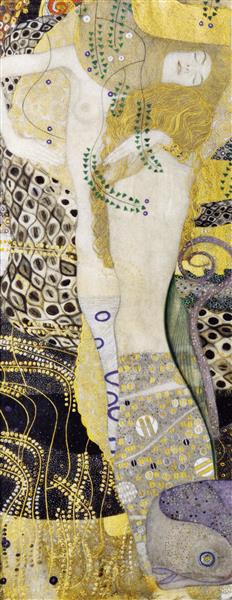
watercolor, parchment · 1907
Medium
watercolor, parchment
Period
Art Nouveau (Modern) · Japonism
Held at
Belvedere, Vienna, Austria