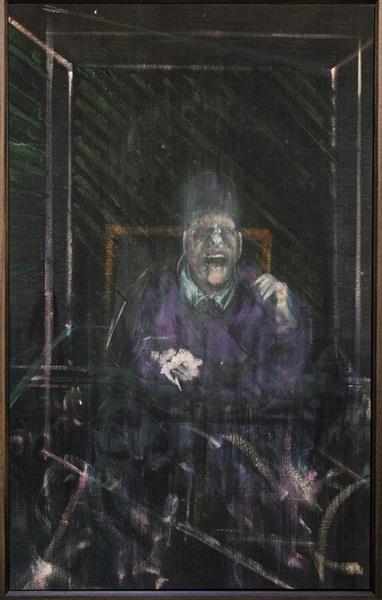
Untitled (Pope)
Private Collection
Francis Bacon, 1954
The formidable presence of Pope Innocent X, as envisioned by Francis Bacon in 1954, immediately arrests attention. This work is a vivid instance of Bacon's Expressionism, where the depiction of the pontiff is a deliberate departure from traditional portraiture. Instead of a stately likeness, we encounter a distorted version of the head of the Catholic Church, a figure historically immortalized by Diego Velázquez. This approach isn't isolated; the work belongs to a significant series, part of an extended exploration by Bacon that generated around 50 distinct variants of Velázquez's "Portrait of Innocent X." From 1949 to 1971, Bacon repeatedly returned to this iconic image, transforming the original's dignified portrayal into something unsettling. The sheer volume of these interpretations suggests an intense, almost obsessive engagement with the subject and its historical weight. What compels an artist to so dramatically re-envision an already powerful image, creating a spectral echo of its source? The distortion challenges our perception of authority, leaving a lingering impression of both reverence and unease.
No thoughts yet. Be the first to share one.
TagsExpressionismfigurativeportrait
5.00 (1 rating)
1954
Period
Expressionism
Held at
Private Collection

.jpg!Large.jpg)