Fury
Private Collection
Francis Bacon, 1944
The name 'Fury' alone, applied to a 1944 oil on board by Francis Bacon, sets an expectation for raw, unsettling imagery. This piece, categorized within Expressionism, would inherently forgo serene representation, instead embracing distorted forms to convey powerful emotional states. Bacon, an Irish-born British figurative painter, became renowned for his intensely focused depictions of the human form. His works often feature abstracted figures, frequently isolated within stark, almost cage-like geometrical structures. One can thus anticipate a visceral impact from this painting, perhaps a figure twisted by the very emotion of fury, rendered in oil with a boldness that speaks to agitation. The medium would allow for a tactile quality, emphasizing the psychological depth over photographic likeness. What lingers is the profound absence of specific visual details, compelling one to mentally construct the scene. How does Bacon, through his signature approach, transform this potent emotion into visible form, particularly within the constrained space of board? The question itself intensifies the experience, a hallmark of his unsettling artistic vision.
No thoughts yet. Be the first to share one.
TagsExpressionismoilboardfigurativemythological painting
5.00 (1 rating)
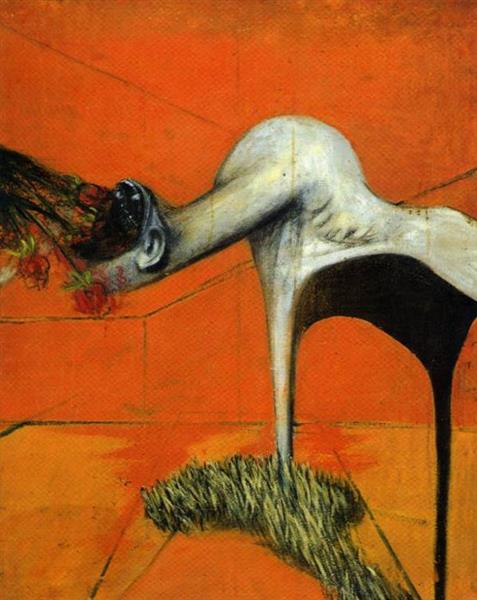
oil, board · 1944
Medium
oil, board
Period
Expressionism
Held at
Private Collection
.jpg!Large.jpg)
.jpg!Large.jpg)