Two Little Girls
Albertina, Vienna, Austria
Egon Schiele, 1911
The very thought of Egon Schiele approaching a subject like "Two Little Girls" immediately conjures a tension between expected innocence and his renowned artistic intensity. Executed in 1911 using watercolor on paper, this Expressionist piece likely distorts any simple charm, instead conveying figures marked by the artist's signature expressive line. Schiele, an Austrian painter known for his raw emotionality and often twisted body shapes, filtered the human form through a distinctly unsettling lens. As an early exponent of Expressionism, mentored by Gustav Klimt, his work pushed beyond mere representation. One wonders how his typical intensity manifests when depicting such young subjects. Do these girls exhibit the characteristic Schielean angst or a stark, unblinking presence? The fragility of watercolor might be juxtaposed against an underlying psychological weight, creating a powerful, unsettling image. The medium itself, applied to paper, lends itself to both delicate washes and sharp, cutting strokes, a duality that could amplify the disquieting nature inherent in much of Schiele's output. This artwork, rather than being a sweet portrayal, likely forces a re-evaluation of childhood through a profoundly expressive, perhaps even confrontational, perspective.
No thoughts yet. Be the first to share one.
TagsExpressionismwatercolorpaperportrait
4.00 (1 rating)
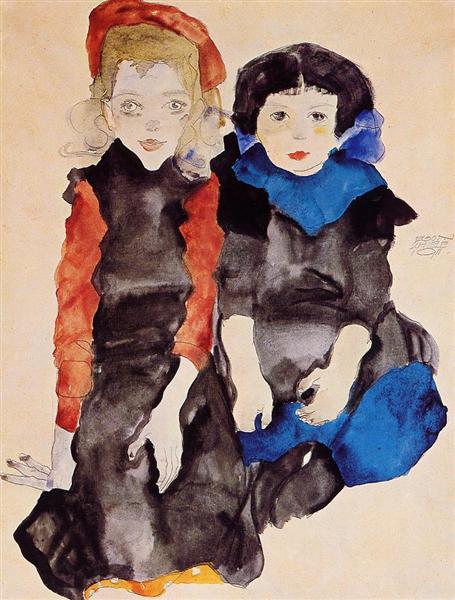
watercolor, paper · 1911
Medium
watercolor, paper
Period
Expressionism
Held at
Albertina, Vienna, Austria