Two Girls Lying Entwined
Albertina, Vienna, Austria
Egon Schiele, 1915
The intimate, perhaps vulnerable, sight of two figures lying entwined immediately commands attention. This artwork, created by Egon Schiele in 1915, uses watercolor on paper. The medium itself, watercolor, suggests a directness and transparency, allowing the forms of the two girls to emerge with a certain immediacy on the paper. The very act of depicting them "entwined" speaks to a specific composition that emphasizes closeness and perhaps a challenging ambiguity in their relationship. As a work of Expressionism, this piece aligns with a focus on emotional experience rather than objective representation, prioritizing an aesthetic visual form that expresses human creativity. The choice of watercolor for such a subject underscores a potential fragility or fleeting nature of the moment. The stark simplicity of the medium on paper, combined with the emotionally charged subject of entwined figures, creates a tension. It is not about grand scale but about intense, focused human connection, or its unraveling. The piece lingers, prompting thought on the subtle, often complex layers of human relationships, laid bare through the artist's engagement with the expressive possibilities of watercolor on paper.
No thoughts yet. Be the first to share one.
TagsExpressionismwatercolorpapernude painting (nu)
4.50 (1 rating)
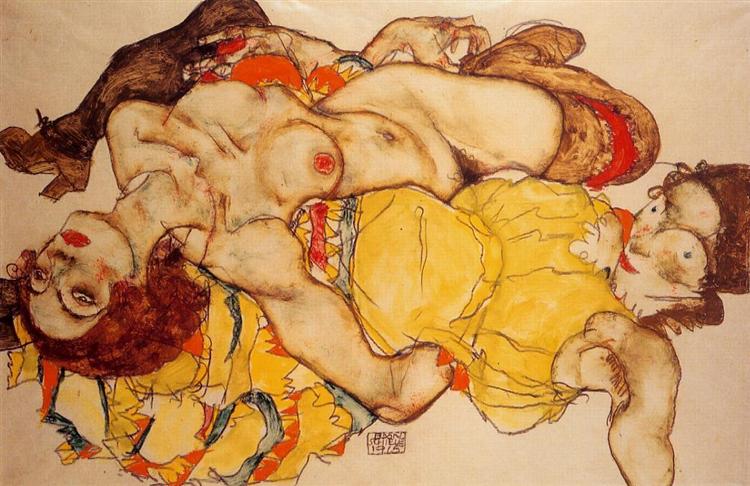
watercolor, paper · 1915
Medium
watercolor, paper
Period
Expressionism
Held at
Albertina, Vienna, Austria