The Virgin of the Rocks
National Gallery, London, UK
Leonardo da Vinci, 1505
Imagine encountering a familiar narrative, but rendered twice by the same hand, with nuances that make you question the very nature of artistic creation. That's the compelling situation with Leonardo da Vinci's "The Virgin of the Rocks." These aren't casual variations; we're talking about two monumental paintings, each nearly two meters high, by the same artist, sharing a composition described as "identical except for several significant details." Both were originally executed in oils on wooden panels, a medium that allows for rich textures and deep coloration, well suited for depicting the dramatic, namesake rocky setting. The version residing in the Louvre in Paris, now transferred from its original panel to canvas, remains unrestored, presenting a raw, unfiltered glimpse into da Vinci's vision. Its twin, located in the National Gallery, London, experienced a restoration between 2008 and 2010, which undoubtedly brought new life to its surface, perhaps re-emphasizing the subtle interplay of light and shadow on the figures and the surrounding stone.It’s fascinating to consider da Vinci's meticulous preparatory process, as evidenced by earlier "Compositional Sketches for the Virgin Adoring the Christ Child, with and without the Infant St. John the Baptist," rendered with silverpoint and ink on pink paper. These early studies highlight his deep engagement with the spatial arrangement of the figures—the Virgin, Christ Child, and Infant St. John—within their envisioned rocky enclosure. The sheer scale of these finished oil paintings, approaching two meters, must envelop the viewer, drawing them into the cavernous scene where light might pierce through cracks in the rock or softly illuminate the figures. The choice of oil on panel for the original works would have allowed for meticulous layering and sfumato, creating a sense of depth and mystery within these identical yet distinct compositions. What motivates an artist to revisit and subtly alter such a grand vision, and how does the contrasting state of their preservation—one untouched, one revived—shape our understanding of da Vinci's enduring artistic intention?
No thoughts yet. Be the first to share one.
TagsHigh Renaissanceoilpanelreligious painting
5.00 (1 rating)
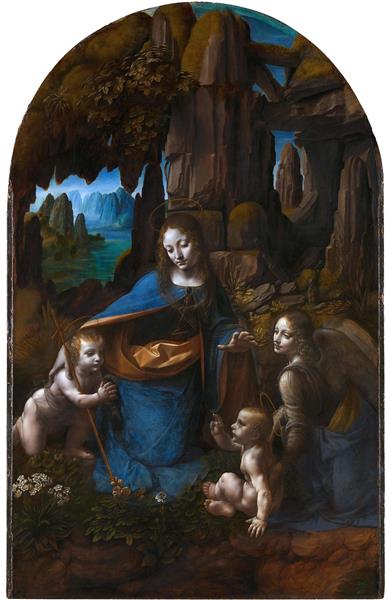
oil, panel · 1505
Medium
oil, panel
Period
High Renaissance
Held at
National Gallery, London, UK