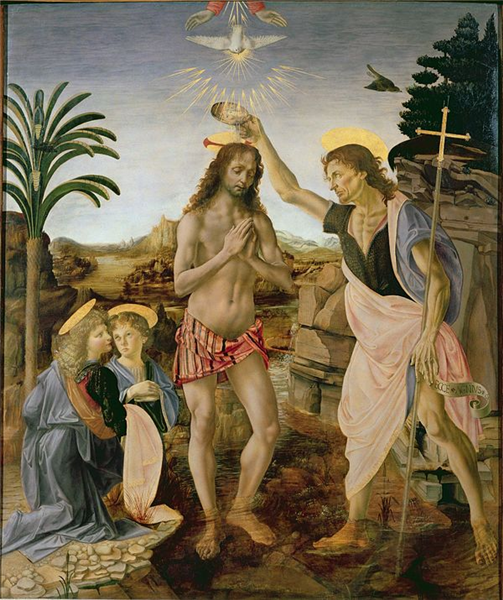
The Baptism of Christ
Uffizi Gallery, Florence, Italy
Leonardo da Vinci, 1475
The audacious use of oil, panel, and tempera in Leonardo da Vinci's 1475 'The Baptism of Christ' immediately signals a work of profound technical curiosity, especially for the Early Renaissance. This blend of media would have offered da Vinci an exceptional palette of textural possibilities: the enduring luminosity and crisp detail of tempera on the panel, perhaps establishing the foundational forms, contrasted with the adaptable, light-absorbing qualities of oil for nuanced shading and atmospheric effects. It’s not hard to imagine how this innovative approach would have allowed for an interplay between matte and shimmering surfaces, pushing the boundaries of what was visually achievable. Without specific details of its composition or figures in the available records, one is left to appreciate the sheer experimental spirit embedded in its very construction. The decision to unite such distinct artistic tools in a single devotional subject forces us to consider the underlying creative tension—how might the precise, almost graphic nature of tempera have converged with the rich, blending capacity of oil? This technical ambition, even without visual specifics, paints a compelling picture of an artist at the forefront of material exploration, leaving us to wonder about the particular light and depth he ultimately conjured.
No thoughts yet. Be the first to share one.
TagsEarly Renaissanceoilpaneltemperareligious painting
5.00 (1 rating)
oil, panel, tempera · 1475
Medium
oil, panel, tempera
Period
Early Renaissance
Held at
Uffizi Gallery, Florence, Italy