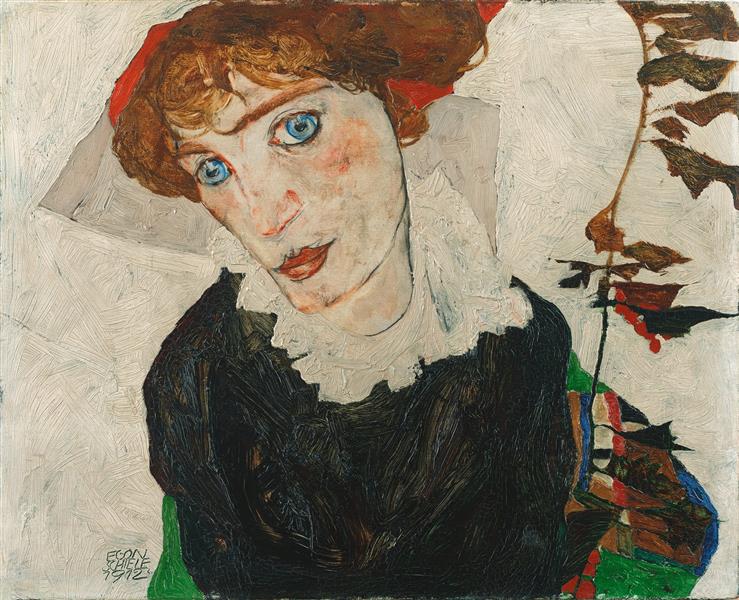
Portrait of Valerie Neuzil
Leopold Museum, Vienna, Austria
Egon Schiele, 1912
To consider a portrait by Egon Schiele from 1912, created in oil on panel, places us squarely within the Art Nouveau movement's later expressions, hinting at a distinct Modernist sensibility. Titled "Portrait of Valerie Neuzil," the subject's identity is given, inviting an immediate contemplation of the personal connection, often so central to Schiele’s known explorations of the human psyche. Without specific visual documentation for this particular piece, one can only infer the potential intensity and directness that typically define the artist's approach to the human form. The medium of oil on panel, characteristic of the era, might suggest a particular surface quality, perhaps a deliberate rawness or a stark precision, reflecting the Modernist shift Schiele was part of. The very idea of a named individual, Valerie Neuzil, being rendered by Schiele in this period, makes one wonder about the emotional weight carried by the unseen brushstrokes. How does a single figure emerge from the panel in this context? What silent narrative is etched into the surface, given the year and the artist’s reputation for unflinching psychological insight? The absence of detailed visual information for this specific work leaves the potential impact of its composition and palette largely to the imagination, yet the metadata alone points to a significant moment in the artist's output.
No thoughts yet. Be the first to share one.
TagsArt Nouveau (Modern)oilpanelportrait
4.00 (1 rating)
oil, panel · 1912
Medium
oil, panel
Period
Art Nouveau (Modern)
Held at
Leopold Museum, Vienna, Austria