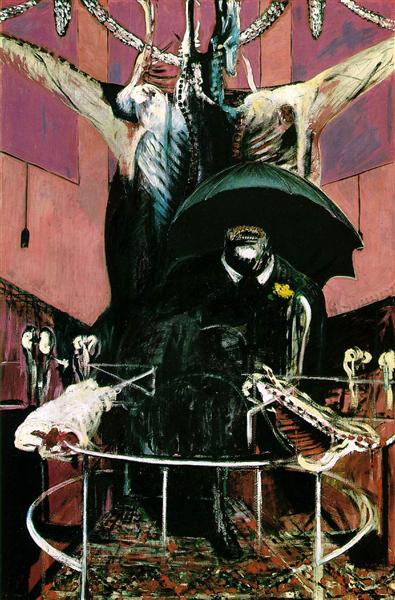
Painting 1946, Second Version
Francis Bacon, 1971
The very title, "Painting 1946, Second Version," offers a fascinating temporal echo. Created in 1971, it's intriguing to consider Francis Bacon’s decision to revisit a work from a quarter-century prior, hinting at a prolonged engagement with certain themes or a specific moment in his own artistic journey. As an Expressionist work, one might anticipate a profound psychological intensity, a departure from pure representation to convey a raw, perhaps unsettling, emotional landscape. Bacon’s pieces from this movement often delve into the visceral and fragmented aspects of human experience. This "Second Version" might imply a re-evaluation or a deepened exploration of the original 1946 concept, perhaps intensified by decades of further artistic development. Without specific details on medium, the focus is squarely on the expressive force itself. We can imagine forms that might be distorted, colors used for their emotional weight rather than their descriptive accuracy, creating an almost palpable sense of unease or confrontation. The question lingers: what unresolved tension from 1946 compelled Bacon to return to it in such a distinct manner?
No thoughts yet. Be the first to share one.
TagsExpressionismallegorical paintingsymbolic painting
5.00 (1 rating)
.jpg!Large.jpg)
1971
Period
Expressionism
.jpg!Large.jpg)