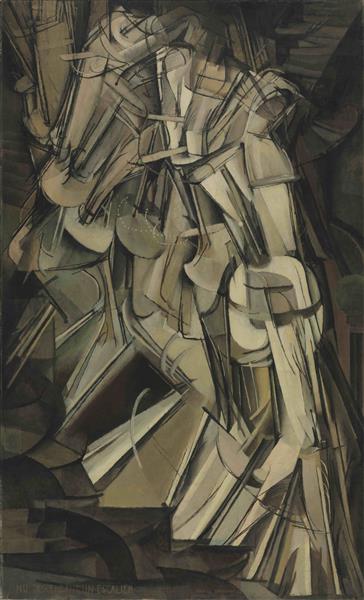
Nude Descending a Staircase, No.2
Philadelphia Museum of Art, Philadelphia, PA, US
Marcel Duchamp, 1912
The canvas seems to vibrate with a kinetic energy, capturing a "nude descending a staircase" not as a singular figure, but as a series of sequential moments compressed onto a single plane. This 1912 oil on canvas presents a figure fractured into geometric shards, implying a relentless, almost mechanical motion rather than a fluid human form. This audacious approach to radical abstraction was so novel that it caused a stir even among avant-garde circles; at the 1912 Salon des Indépendants in Paris, the Cubists themselves rejected the piece, finding its dynamic style "too Futurist." Yet, paradoxically, it later found a place alongside Cubist works in Barcelona, underscoring its liminal position at the cutting edge of European modernism.
The controversy only intensified. When it traveled to the 1913 Armory Show in New York City, it was met with widespread ridicule, cementing its status as a symbol of art's challenging new direction. Its profound impact stretched across generations, provoking reactions both adoring and dissenting. A particularly illuminating example comes from Gerhard Richter, whose 1965 "Woman Descending the Staircase" directly evokes Duchamp's iconic subject. Richter, surprisingly, wasn't offering homage but rather a protest. He articulated a clear rejection, stating he "could never accept that it had put [an end], once and for all, to a certain kind of painting." This statement reveals an unexpected angle: Duchamp's work wasn't merely innovative; it was perceived by some as so definitive, so boundary-setting, that it necessitated a counter-argument. Richter’s own method, blurring figures into a "slightly out-of-focus quality" to achieve elusive forms and reinforce motion, subtly acknowledges the very problems of representation and sequentiality that Duchamp first tackled. The work, therefore, doesn't just represent a moment in time, but continues to pose fundamental questions about what painting can achieve, challenging artists to respond to its powerful, perhaps even definitive, visual statement.
No thoughts yet. Be the first to share one.
TagsCubismFuturismoilcanvasfigurative
3.00 (1 rating)
oil, canvas · 1912
Medium
oil, canvas
Period
Cubism · Futurism
Held at
Philadelphia Museum of Art, Philadelphia, PA, US