Bicycle Wheel
Israel Museum, Jerusalem, Israel
Marcel Duchamp, 1913
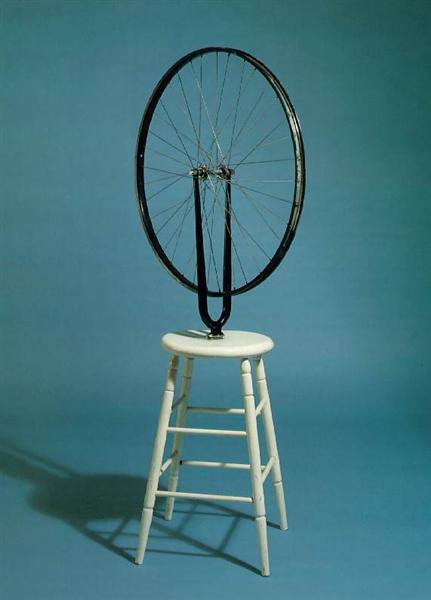
Imagine a common bicycle wheel, detached from its function and inverted, balanced precariously on a wooden stool. That’s the striking image of Marcel Duchamp’s Bicycle Wheel from 1913, an object that immediately challenges what we consider art. The piece, an early readymade, consists quite literally of these two commonplace items, stripped of their usual context. It's often cited as one of the first examples of kinetic sculpture, not because it's powered, but because the wheel itself implies potential movement, a subtle invitation to spin it. What lingers, though, is the understanding that Duchamp didn't originally conceive of this assembly as an artwork at all. This simple combination of industrial and domestic objects fundamentally re-evaluates the role of the artist's hand versus the artist's idea. It's just a wheel on a stool, yet its mere existence asks profound questions about intention, observation, and the very definition of a sculptural form.
No thoughts yet. Be the first to share one.
TagsDadaKinetic Artready-madeinstallation
4.50 (1 rating)
ready-made · 1913
Medium
ready-made
Period
Dada · Kinetic Art
Held at
Israel Museum, Jerusalem, Israel