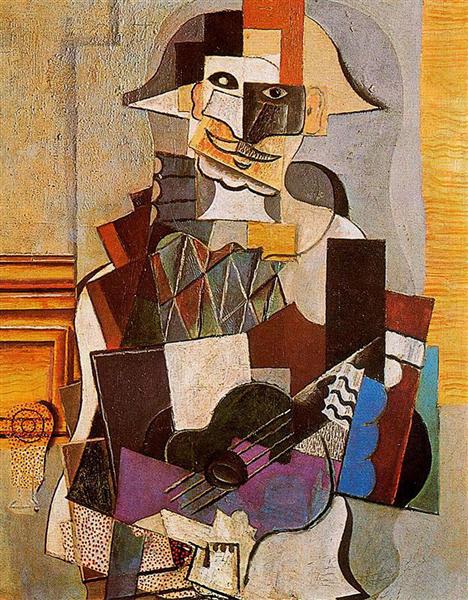
Harlequin with guitar
Pablo Picasso, 1918
In 1918, Pablo Picasso turned his attention to the enigmatic figure of the Harlequin, here notably depicted with a guitar in oil on canvas. While contemporary sources reveal a Picasso creating a 'Woman, Amor, and Harlequin Playing the Guitar' as a detailed graphite drawing in a Cubist style, this particular 'Harlequin with guitar' is identified by its medium—oil on canvas—and its movement—Expressionism. This juxtaposition within the same year suggests an intriguing divergence in Picasso's artistic exploration. One is left to imagine the potential visual qualities of this piece: a departure from the sharp, analytical precision of Cubist graphite lines, perhaps towards a looser, more emotionally resonant brushwork or a palette of vibrant, psychologically charged colors characteristic of Expressionism. The Harlequin, a recurring motif throughout Picasso's career, and the guitar, a frequent symbol in his work, would likely be rendered with a compelling tension, reflecting either a somber introspection or a whimsical energy, a visual mystery that lingers.
No thoughts yet. Be the first to share one.
TagsExpressionismoilcanvasgenre painting
5.00 (1 rating)
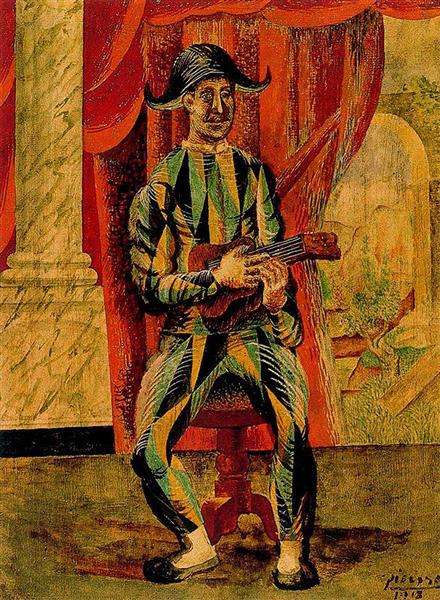
oil, canvas · 1918
Medium
oil, canvas
Period
Expressionism