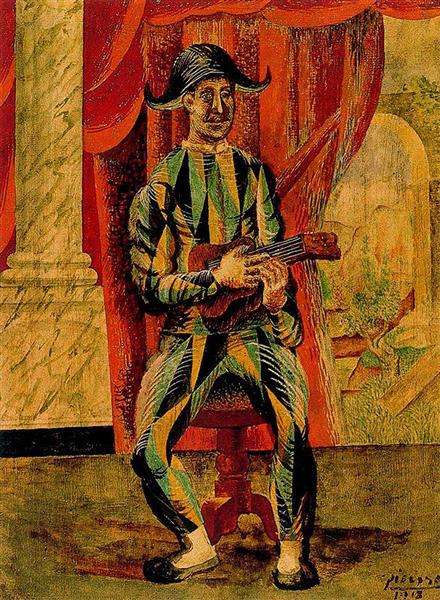
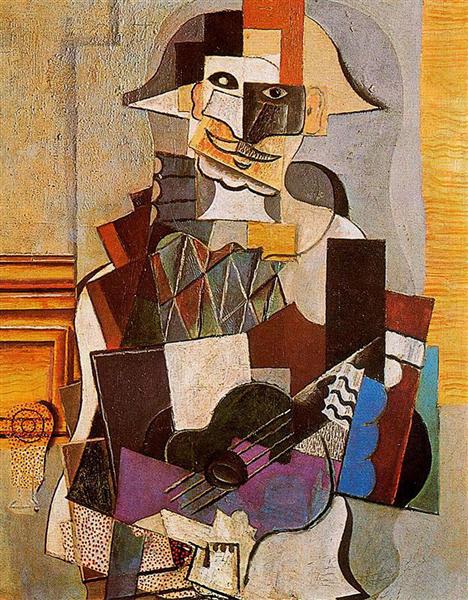
Harlequin
Pablo Picasso, 1918
Harlequin," a work by Pablo Picasso from 1918, identifies itself as belonging to the Cubism movement. What is immediately striking, or perhaps intriguing, is the listed medium: unknown. This missing detail profoundly shapes how one might approach understanding the piece, as the material choices often dictate texture, light interaction, and the very physicality of the artwork. Without a definitive medium, the actual tactile experience or even the scale of this particular Harlequin remains undescribed. Is it a dense oil, a delicate drawing, or perhaps a collage? This absence means we cannot speak to specific colors, the fragmentation of form characteristic of Cubism as applied here, or the pose of the figure. The title itself suggests a familiar, often melancholic character within Picasso's broader oeuvre, yet for this specific 1918 rendering, the visual specifics are unrecorded in the available information. One is left to ponder the nature of a Cubist Harlequin from this year, existing purely as a conceptual entity rather than a visually documented one. The lack of descriptive sources creates a fascinating distance, compelling us to consider how much our appreciation of a work relies on its documented visual presence.
No thoughts yet. Be the first to share one.
TagsCubismportrait
3.75 (2 ratings)
1918
Period
Cubism