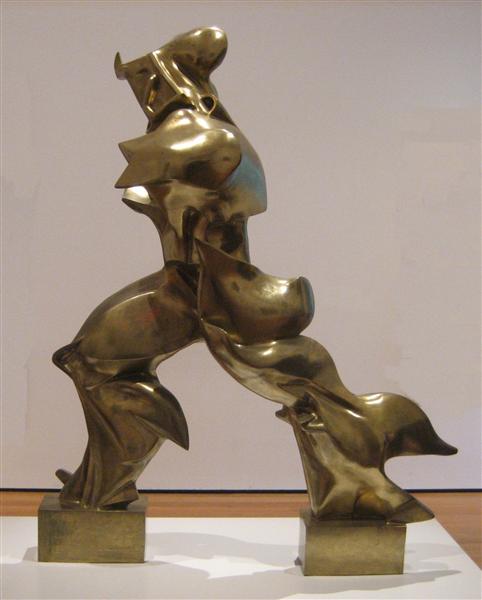
The raw force of forward momentum hits you first, almost like a physical sensation of air rushing past. Umberto Boccioni's "Unique Forms of Continuity in Space" isn't a static figure; it’s an urgent articulation of dynamic speed, presenting a human form that appears to generate and push against unseen resistance simultaneously. The bronze, rather than creating a rigid shell, seems to melt and ripple, flowing around the figure as if it’s literally cutting through the air, creating aerodynamic trails in its wake. Notice how the human shape is stripped of conventional anatomical detail, particularly the absence of arms, which aren't merely missing but deliberately streamlined away. This choice transforms the figure, making it appear less organically human and more like a finely tuned engine of motion. It gives a profound impression of a body not just moving, but actively becoming one with its movement, blurring the lines between organism and mechanism. This is the visual rendering of Boccioni's concept of "a synthetic continuity," where the figure and its environment are fused by the act of progression. The deep folds and swirling contours of the material itself suggest the powerful drag of forceful winds, making the bronze appear fluid. Created in 1913 as a Futurist sculpture, this piece powerfully expresses the movement and fluidity that defined the avant-garde of its era. The bronze medium gives it a solid yet inherently dynamic presence, even if the specific artwork we engage with was cast later in 1950. The artist's decision to sculpt the figure without arms brings to mind a fascinating dialogue with classical precedents like the Nike of Samothrace or Auguste Rodin's "Walking Man." Like those iconic figures, Boccioni's sculpture relies on the sheer power of its striding posture to convey meaning, yet it radically reinterprets heroic motion for the modern, industrialized age. Perhaps the most unexpected detail is how this intense, almost aggressive, vision of modernity and speed has transcended the art world: you can find this very sculpture depicted on the obverse of the Italian 20 cent euro coin. It’s a strange and compelling juxtaposition to imagine such a powerful, almost abstract representation of kinetic energy miniaturized onto currency, a daily, tangible reminder of Boccioni's potent vision, still pushing boundaries and making us feel that invisible, rushing wind today.
No thoughts yet. Be the first to share one.