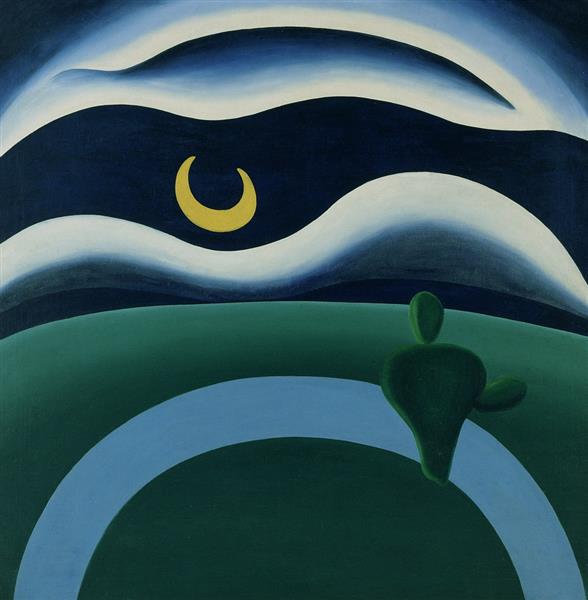
The Moon
do Amaral Tarsila, 1928
Imagining a vision of the moon from Tarsila do Amaral, one immediately anticipates a scene steeped in the vivid, almost childlike dream logic of Surrealism, infused with the distinct spirit of Brazilian modernism she championed. As a leading Latin American modernist, do Amaral consistently pursued a nationalistic expression in her art. "The Moon" from 1928, classified under Naïve Art and Primitivism, strongly suggests simplified forms and bold, perhaps unexpected colors. We might envision a celestial body, possibly rendered with a primitive flatness or an almost cartoonish simplicity, hovering over a landscape that feels both familiar and deeply strange, echoing her unique blend of influences. This artwork, created the same year she inspired the Antropofagia movement, could subtly hint at a 'cultural cannibalism'—the absorption of European modernism into a uniquely Brazilian vision. What untold visual stories, beyond the title and movements, does this mysterious 'Moon' hold within do Amaral's powerful, modernistic narrative of identity?
No thoughts yet. Be the first to share one.
TagsSurrealismNaïve Art (Primitivism)landscape
3.00 (1 rating)
1928
Period
Surrealism · Naïve Art (Primitivism)
.jpg!Large.jpg)