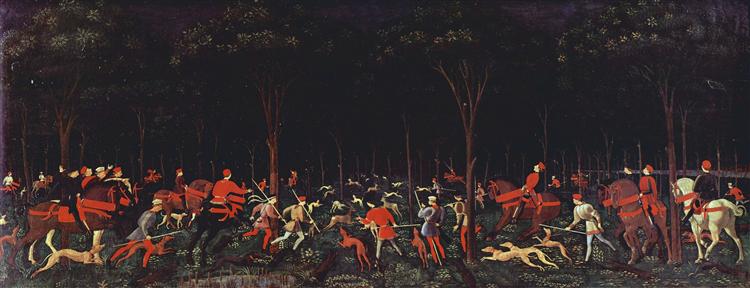
The Battle of San Romano
National Gallery, London, UK
Paolo Uccello, 1440
Imagine encountering a battle scene so vast it sprawls across three distinct panels, each over three meters long. Paolo Uccello's "The Battle of San Romano" isn't just a depiction of conflict; it's a monumental achievement in early Italian Renaissance painting, crafted with egg tempera on wooden panels. These works, commissioned between 1435 and 1460, are unusual for being a major secular commission, breaking from the more common religious subjects of the time. The way Uccello tackles linear perspective in these panels is truly groundbreaking; you can almost feel the receding space, a technique pivotal for the era. The scenes chronicle the 1432 battle between Florentine and Sienese forces, transforming a specific historical event into a dramatic visual experiment. It ’s fascinating to think these ambitious pieces were so admired in the 15th century that Lorenzo de' Medici himself purchased one, and forcibly acquired the other two for his Palazzo Medici. The fact that these three panels, once together, are now divided among the National Gallery, London, the Uffizi in Florence, and the Louvre in Paris, creates a poignant tension. What visual and narrative cohesion is lost when such a grand, multi-panel work is broken apart, scattering its intended impact across continents?
No thoughts yet. Be the first to share one.
TagsEarly Renaissancepoplartemperabattle painting
5.00 (1 rating)
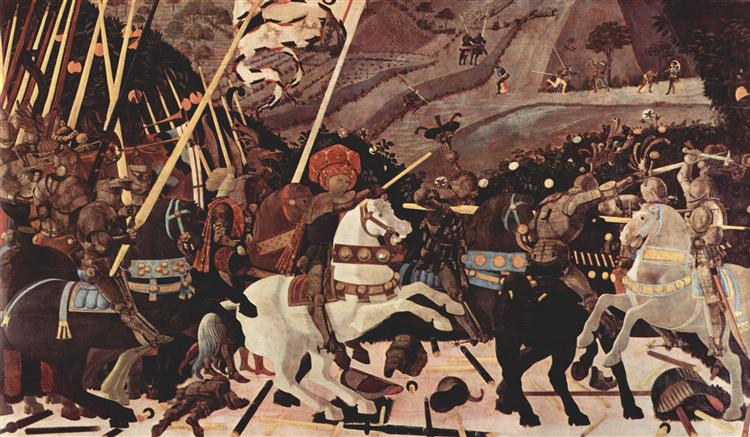
poplar, tempera · 1440
Medium
poplar, tempera
Period
Early Renaissance
Held at
National Gallery, London, UK