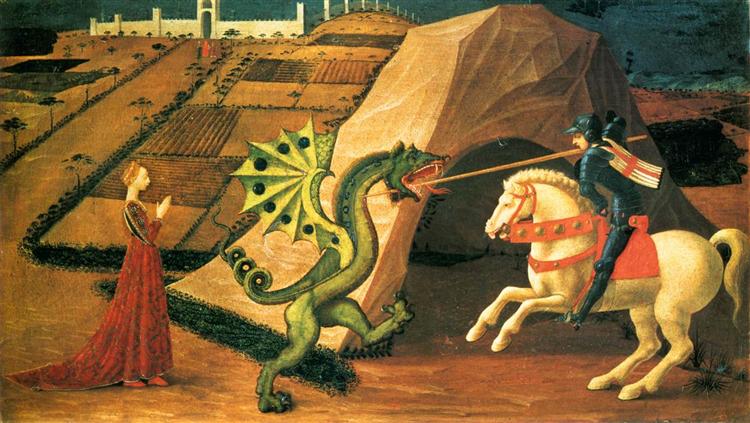
St. George and the Dragon
National Gallery, London, UK
Paolo Uccello, 1470
Imagine the terror of a princess chosen as a daily human tribute, walking towards a dragon's cave, after her village had run out of livestock and trinkets. This scene, depicting the legend of Saint George, likely captures the dramatic confrontation as the saint encounters her, questions her tears, and learns of the dragon's atrocities. Rather than fleeing, as she urges, St. George prepares to confront the beast. This work, created in 1470 by Paolo Uccello using oil on canvas, belongs to the Early Renaissance movement. It visually recounts the moment the saint refuses to abandon the princess, bravely slays the dragon, and ensures her rescue. The narrative, originally set in Cappadocia in earlier sources, later shifted to Libya in the 13th-century Golden Legend, a detail that underscores the legend's evolving interpretation. This medium of oil on canvas, characteristic of its period, would lend a certain depth and richness to the depiction of such a harrowing and heroic tale. One wonders about the specific visual choices Uccello made to portray the dragon's menace and St. George's resolute courage.
No thoughts yet. Be the first to share one.
TagsEarly Renaissanceoilcanvasreligious painting
5.00 (1 rating)
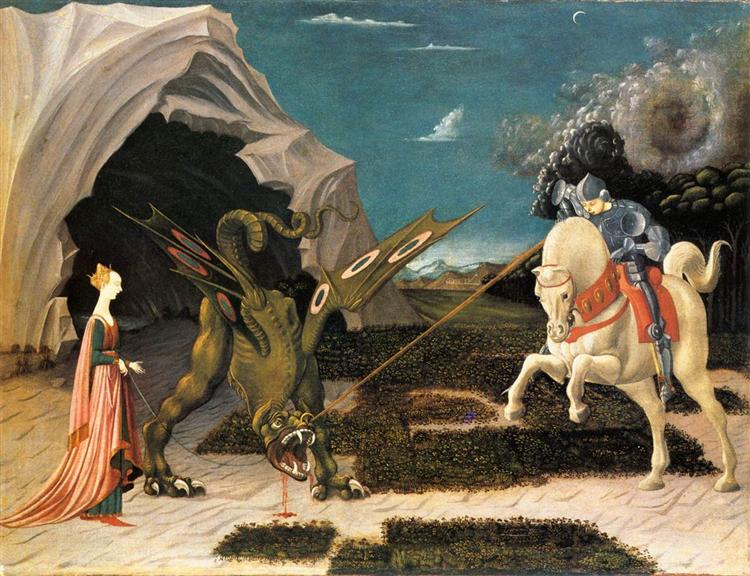
oil, canvas · 1470
Medium
oil, canvas
Period
Early Renaissance
Held at
National Gallery, London, UK