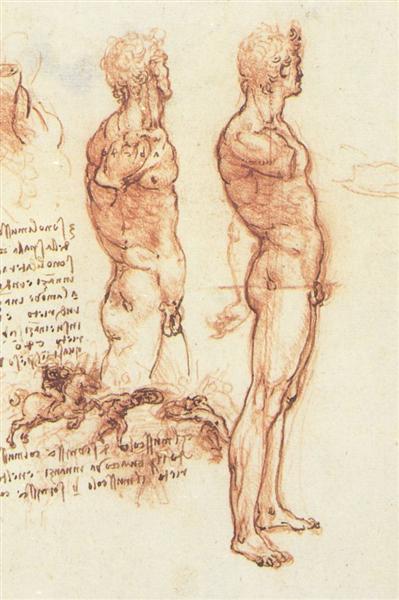
The anatomy of a male nude and a battle scene
Leonardo da Vinci, 1505
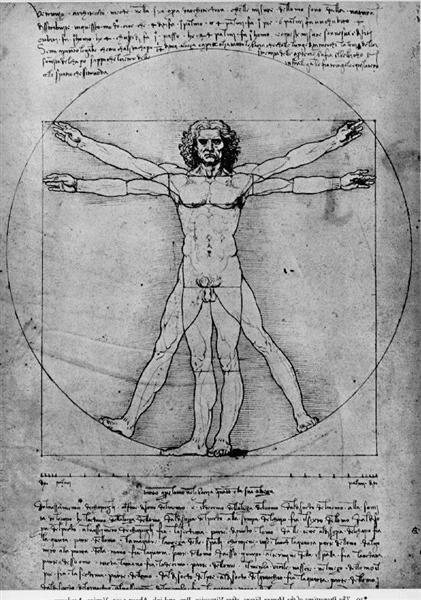
Imagine the meticulous study of the human form clashing with raw, visceral action on a single surface. Leonardo da Vinci, working around 1505, explores the very fabric of existence here. We envision a male nude, his anatomical precision laid bare, perhaps in a pose that reveals every sinew and bone. This isn't just a figure; it's a deep inquiry into what makes us move, what gives us form. The gaze would linger on the contours, the articulation of the body, a silent, profound understanding of structure. Then, abruptly, the world explodes into a battle scene. Perhaps alongside or intertwined, we might see figures caught in the throes of conflict, dynamic and violent. Spears might pierce, bodies might contort in struggle, horses rear—all captured with the urgency of instantaneous motion. How do these two disparate worlds—the serene, scientific observation of a lone body and the chaotic maelstrom of collective violence—coexist? The work would pull you between them, the internal mechanisms of a body against the external forces that tear it apart. Coming from the High Renaissance, this approach would have pushed boundaries, merging scientific rigor with dramatic narrative. The artist's chosen medium remains unknown, which only adds to the mystery, leaving us to ponder if it was a meticulous drawing, an intense study in tempera, or something else entirely—a stark exploration of life and death, stillness and motion, all rendered by the hand of Leonardo da Vinci.
No thoughts yet. Be the first to share one.
TagsHigh Renaissancesketch and study
5.00 (1 rating)
1505
Period
High Renaissance