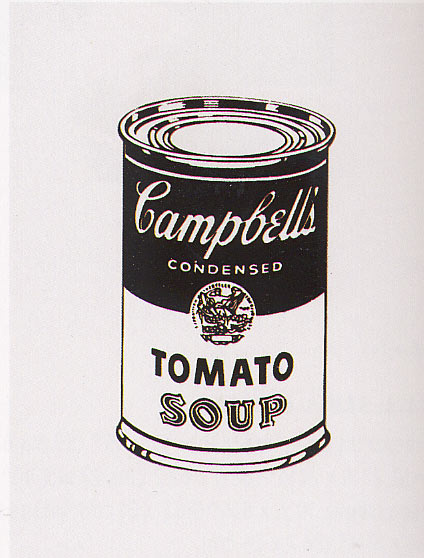
Campbell's Soup Can (Tomato)/Retrospective Series
Andy Warhol, 1978
Imagine seeing that familiar label, a Campbell's Soup Can, but rendered not as an advertisement, but as art, through the cool, detached precision of a silkscreen. This artwork, part of Andy Warhol’s 1978 Retrospective Series, takes the iconic form of the "Tomato" variant, likely presenting its distinct red and white color scheme with a graphic flatness characteristic of the medium. The very choice of a silkscreen, a process of mechanical reproduction, challenges the traditional boundaries between high and low culture. Warhol, a leading figure in the Pop art movement, frequently used such methods to explore the relationship between advertising, consumerism, and mass media. The visual impact is immediate: a commercial product, instantly recognizable, stripped of its grocery shelf context and elevated to a singular image. There's a curious tension in this transformation. Other works by Warhol also engaged with the Campbell's Soup can motif, even appearing as simple drawings in black marker or ballpoint pen years earlier. Here, the silkscreen elevates that simple line work into a bold, mass-produced statement. It makes you wonder what happens when an object designed for consumption becomes the object of contemplation, endlessly reproducible yet singular on the gallery wall.
No thoughts yet. Be the first to share one.
TagsPop Artsilkscreenstill life
3.00 (1 rating)
silkscreen · 1978
Medium
silkscreen
Period
Pop Art