Red Vineyards at Arles
Pushkin Museum, Moscow, Russia
Vincent van Gogh, 1888
The vibrancy suggested by 'Red Vineyards at Arles' immediately pulls you in, imagining fields awash in striking crimson and russet tones. Painted by Vincent van Gogh in 1888, this oil on canvas embodies the Post-Impressionist approach to color and light. One can envision thick brushstrokes, typical of the movement, building up the texture of the earth and sky, perhaps even the grapevines themselves. The 'Arles' in the title places the scene in a specific, sun-drenched region, which for Van Gogh often translated into intense, non-naturalistic hues. While specific visual details beyond the title are not given, the thought of vineyards in such a state, possibly under an evening light or autumn sun, evokes a powerful sense of season and agricultural labor. How does Van Gogh translate the sheer density of a vineyard onto a canvas with oil? The implied palette—rich reds, deep greens, perhaps a contrasting sky—would contribute to a visually dynamic experience, questioning how much an artist distorts reality to convey emotional truth.
No thoughts yet. Be the first to share one.
TagsPost-Impressionismoilcanvaslandscape
4.00 (1 rating)
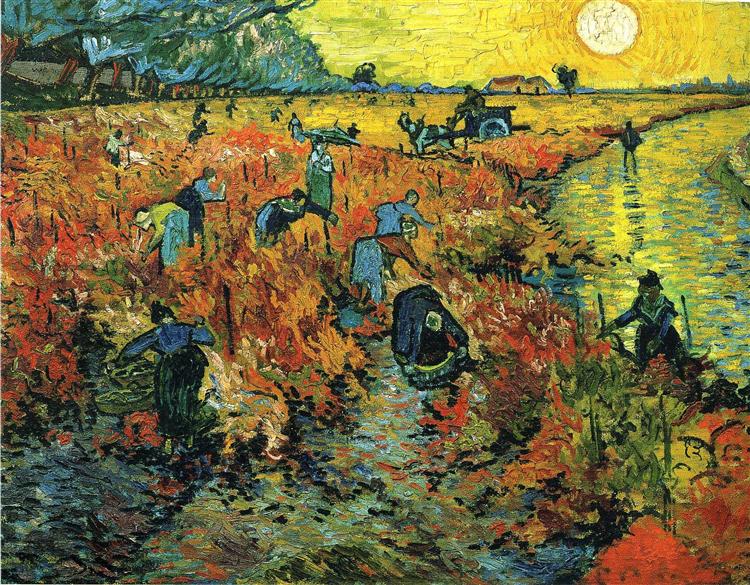
oil, canvas · 1888
Medium
oil, canvas
Period
Post-Impressionism
Held at
Pushkin Museum, Moscow, Russia