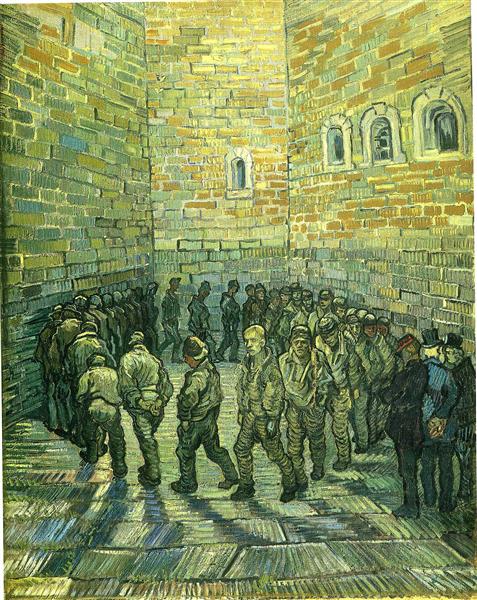
Prisoners Exercising (Prisoners Round)
Pushkin Museum, Moscow, Russia
Vincent van Gogh, 1890
The stark subject of prisoners engaged in a repetitive, circular exercise immediately captures attention. This 1890 oil on canvas by Vincent van Gogh, known as Prisoners Exercising, plunges the viewer into a confined world. What's truly intriguing is the detail that this work is "after Gustave Doré," revealing it as Van Gogh's interpretation of an existing composition. This unexpected context shifts the focus from purely original invention to an artist engaging directly with a powerful predecessor's vision, filtered through his own Post-Impressionist approach. The very notion of a 'round' implies a structured, almost relentless rhythm to the figures, moving in an endless, confined loop within the painting's frame. The medium of oil on canvas suggests a direct, physical application of paint to render this somber subject. This engagement with a prior artist's view of confinement creates a tension, making one consider the enduring visual language of human constraint and how different sensibilities adapt it across time.
No thoughts yet. Be the first to share one.
TagsPost-Impressionismoilcanvasgenre painting
4.00 (1 rating)
oil, canvas · 1890
Medium
oil, canvas
Period
Post-Impressionism
Held at
Pushkin Museum, Moscow, Russia