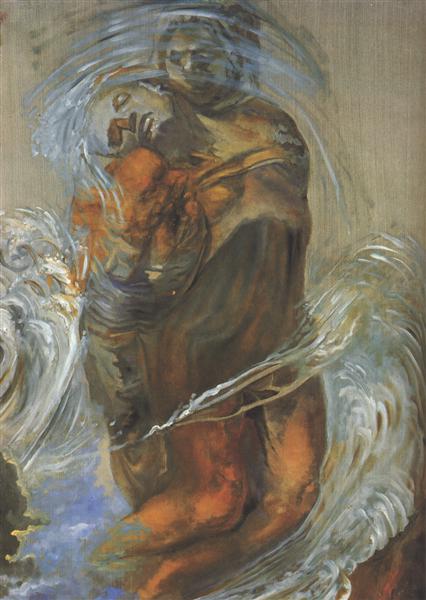
Pieta
Salvador Dali, 1982
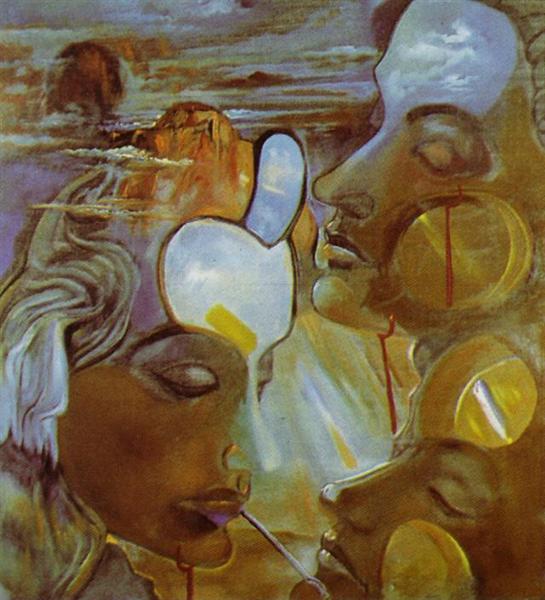
A profoundly unsettling vision of grief likely dominates Dali's 1982 Pieta. Through the medium of oil on canvas, one might expect a deeply subjective interpretation of the iconic scene. Given its grounding in Expressionism and Symbolism, the painting likely distorts traditional forms to convey raw emotion. Perhaps Mary’s anguish is rendered through exaggerated features or a contorted pose, her form merging with or separating from the body of Christ in a psychologically charged way. Dali’s approach would surely favor a symbolic landscape or a stark, theatrical background, perhaps with a sky of turbulent, unearthly hues – deep violet, stark crimson, or unsettling ochre – that reflect an internal spiritual struggle rather than a literal setting. The texture of the oil paint itself might be used to convey a sense of suffering, perhaps thick impasto or thin, almost translucent washes in areas. It's a Pieta not focused on devotional naturalism, but on the very essence of human despair and divine sacrifice, warped by a dreamlike or nightmarish sensibility. How does one truly perceive such a profound moment through Dali’s late, symbolic lens?
No thoughts yet. Be the first to share one.
TagsExpressionismSymbolismoilcanvasreligious painting
4.50 (1 rating)
oil, canvas · 1982
Medium
oil, canvas
Period
Expressionism · Symbolism