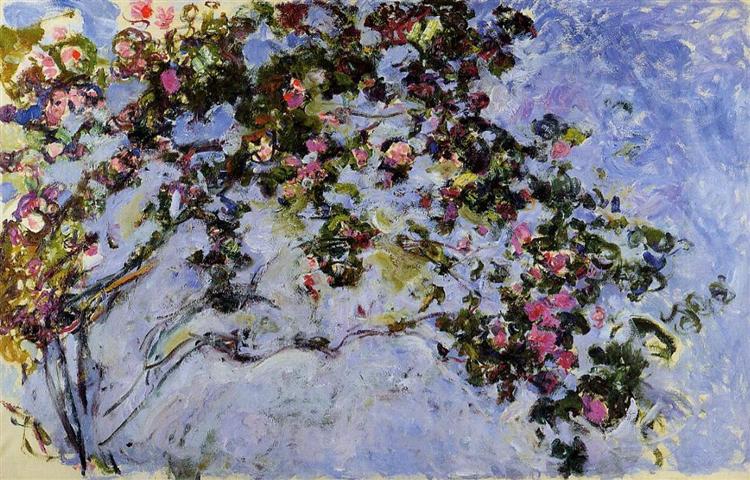
Path under the Rose Trellises
Claude Monet, 1924
The very idea of a "Path under the Rose Trellises" by Claude Monet, created in 1924, immediately conjures an Impressionist's exploration of light and ephemeral beauty. One can envision dappled sunlight filtering through abundant climbing roses, casting shifting patterns of illumination and shadow onto the path below. The trellises themselves would undoubtedly define the perspective, possibly creating a verdant, tunnel-like passage, drawing the eye deeper into a meticulously arranged landscape. It's interesting to consider this work in light of gardening history; such elaborate rose trellises distinctly suggest an ornamental garden, a type of cultivated space that, historically, was often the preserve of the elite. This contrasts sharply with the primarily utilitarian kitchen gardens common for smaller plots. The painting thus represents a focus purely on aesthetic pleasure rather than sustenance, making one reflect on the social context of such designed beauty. The unknown medium also leaves the tactile qualities open to imagination, prompting a lingering question about the specific visual and textural experience Monet sought to evoke in this carefully cultivated scene.
No thoughts yet. Be the first to share one.
TagsImpressionismlandscape
4.00 (1 rating)

1924
Period
Impressionism

.jpg!Large.jpg)