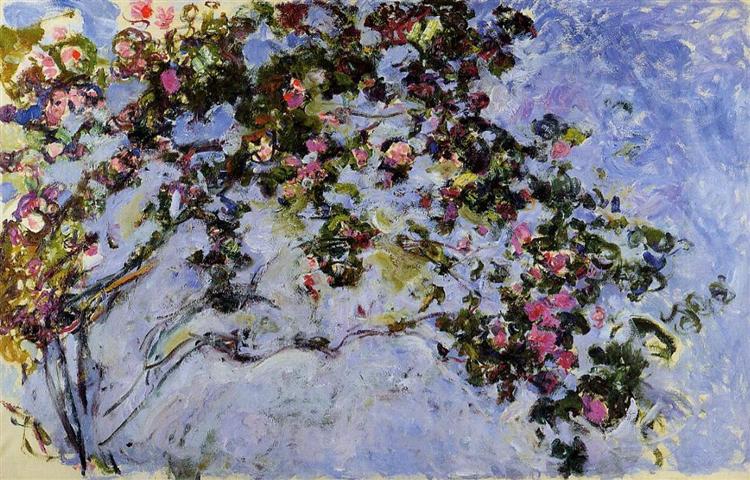
The Rose Bush
Claude Monet, 1926
It's striking to think about how a simple rose bush, created in 1926, fits into the grand, almost obsessive, vision of Claude Monet’s last years. During this period, the French Impressionist was deeply immersed in depicting his Giverny flower garden, a focus that dominated the final three decades of his life. One can imagine how Monet might have rendered the vibrant, fragmented forms of roses and foliage, characteristic of his later style, perhaps dissolving into a haze of color. This visual ambiguity might be amplified by the fact that many of his works from this time were painted while he was suffering from cataracts. The way light and color could have merged, or how the distinct forms of petals and leaves might blend together, offers a poignant glimpse into an artist pushing the boundaries of perception. The absence of a known medium for this work only adds to its mystique, leaving the exact texture or luminosity to the imagination. What remains is the lingering question of how Monet’s personal vision, shaped by both profound dedication and failing eyesight, transformed something as commonplace as a rose bush into an exploration of light and form.
No thoughts yet. Be the first to share one.
TagsImpressionismflower painting
5.00 (1 rating)
1926
Period
Impressionism

.jpg!Large.jpg)