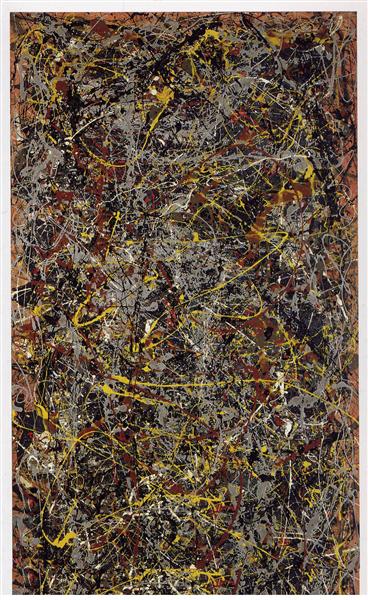
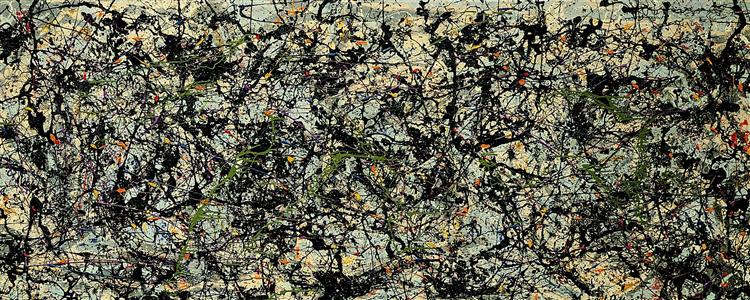
Number 12
Jackson Pollock, 1949
Imagine the raw, unbridled energy that must have gone into a piece like Jackson Pollock's "Number 12" from 1949. This is where you feel the "action" in "Action painting," a core tenet of Abstract Expressionism. Though the specific medium for this work isn't known, it's clear it emerged from Pollock's revolutionary "drip technique." He wasn't simply brushing; he was pouring and splashing liquid household paint onto a horizontal surface, working the canvas from all angles. This approach gave rise to what's often called "all-over painting," where the entire surface vibrates with activity, lacking a central focal point. It's an extreme form of abstraction, born from what was described as a frenetic dancing style, the artist’s whole body engaged in the act. Critics at the time were famously divided by such immediate creation; some lauded its raw power, while others dismissed its apparent randomness. For "Number 12," the absence of a known medium leaves an intriguing question: does this force us to focus purely on the visual impact of the technique, or does it add another layer of abstract mystery to an already enigmatic work?
No thoughts yet. Be the first to share one.
TagsAbstract ExpressionismAction paintingabstract
2.00 (1 rating)
1949
Period
Abstract Expressionism · Action painting
.jpg)