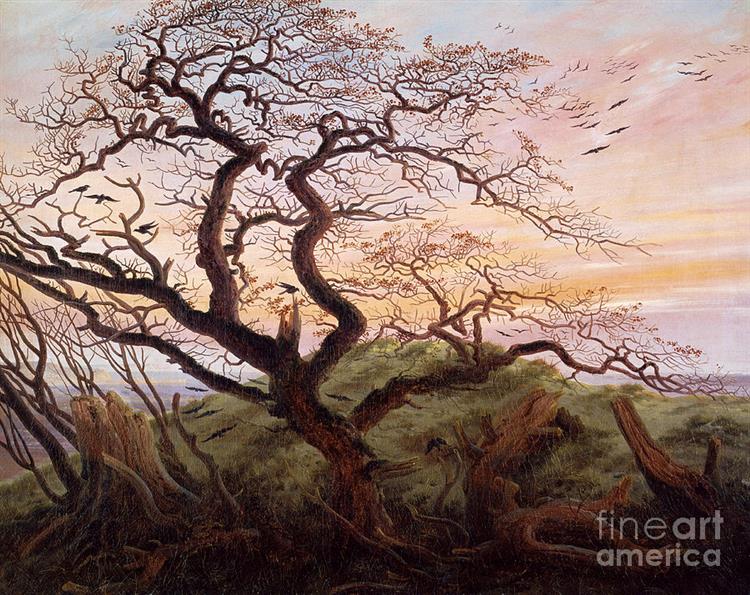
The Tree of Crows
Louvre, Paris, France
David Friedrich Caspar, 1822
A gnarled oak, bare but for a few dead leaves, contorts under an evening sky, its twisted branches hosting two crows as a larger flock descends towards the stark form. The visual goes deeper than a simple landscape; the hill at its very center is identified by an inscription on the canvas's reverse as a Hünengrab, a prehistoric burial ground. Such a detail profoundly shifts the reading of the scene. In the darkened foreground, evidence of decay and transition is starkly visible: a hacked trunk and the upright stump of another oak create a powerful sense of an interrupted natural cycle. Far in the distance, the vast ocean meets the distinctive chalk cliffs of Cape Arkona, a geographical feature frequently revisited by the German Romantic artist Caspar David Friedrich in his 1822 oil painting. The stark contrast between the lone, twisted survivor and the fallen wood, framed by the fading light, leaves one contemplating the cyclical nature of life, death, and enduring memory. The heavy sky and desolate foreground suggest a profound quietude, a moment suspended between what has been and what will be.
No thoughts yet. Be the first to share one.
TagsRomanticismoilcanvaslandscape
2.00 (1 rating)
oil, canvas · 1822
Medium
oil, canvas
Period
Romanticism
Held at
Louvre, Paris, France
.jpg)