Fishblood
Destroyed
Gustav Klimt, 1898
The title alone, "Fishblood", immediately conjures a potent image, especially when paired with Gustav Klimt's known inclination toward Symbolism. Created in 1898, this work relies solely on pen and ink, a choice that instantly suggests a stark, almost primal quality. Without the opulence of gold or the rich hues often associated with the era, the medium dictates a world of line and contrast. One imagines a delicate yet forceful hand at play, rendering form and shadow purely through hatching, stippling, or bold outlines. This monochromatic approach would lend an inherent gravity to the work, forcing a focus on composition and the raw impact of form over decorative flourish. It’s fascinating to consider how the Symbolist pursuit of inner meaning and the mystical finds expression through such an unadorned technique. The absence of color might amplify the symbolic weight of "blood" and "fish," turning them into potent emblems rather than mere depictions. The restrictive nature of pen and ink itself could be seen as an unexpected element, compelling Klimt to convey the depths of Symbolist thought through the most fundamental drawing tools, creating a tension between the visceral subject hinted at by the title and the intellectual rigor of the medium.
No thoughts yet. Be the first to share one.
TagsSymbolismpeninkallegorical painting
4.00 (1 rating)
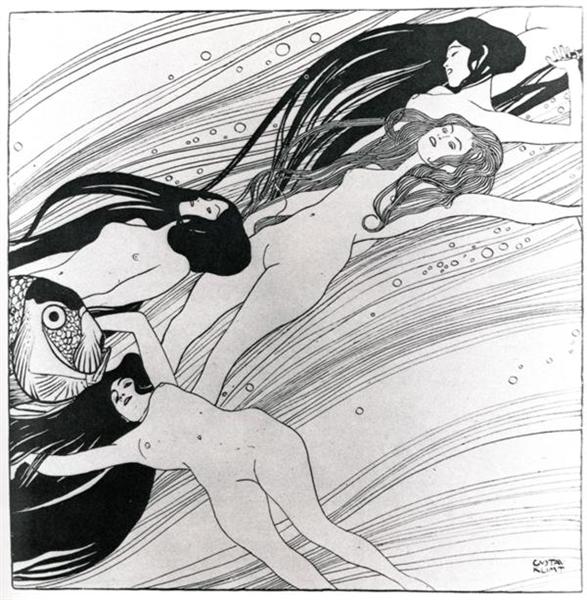
pen, ink · 1898
Medium
pen, ink
Period
Symbolism
Held at
Destroyed