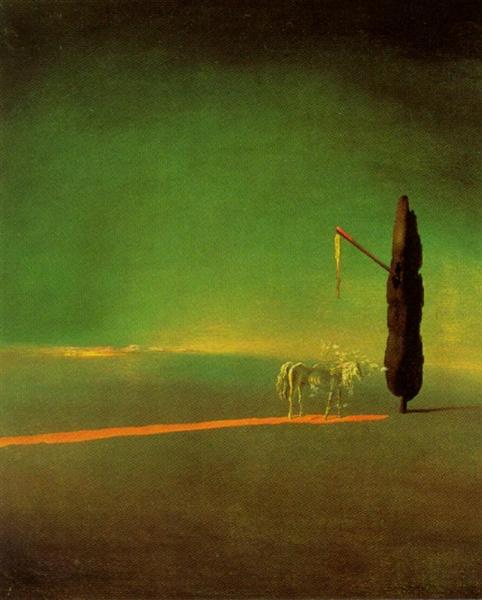
Eclipse and Vegetable Osmosis
Salvador Dali, 1934
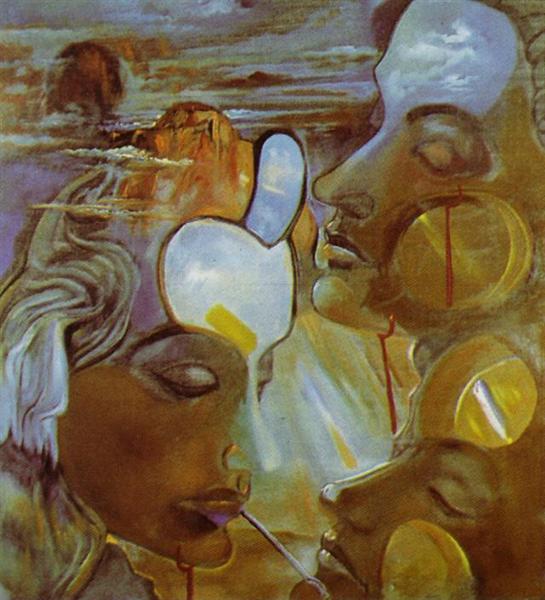
What kind of visual alchemy occurs when a grand celestial event like an eclipse merges with the microscopic absorption of 'vegetable osmosis'? This intriguing question lies at the heart of Salvador Dali's 1934 work, 'Eclipse and Vegetable Osmosis.' As a piece firmly rooted in the Surrealist movement, its very title hints at the unexpected juxtapositions and dreamlike logic characteristic of the artist. The medium of this particular creation remains unknown, further adding to the mystery surrounding its physical manifestation. Without specific visual details, it's challenging to describe its actual appearance, colors, or compositional details. We are left to ponder how Dali might have explored themes of growth, decay, light, and obscurity through these chosen motifs, bringing together the cosmic scale with an organic process. What strange, symbiotic relationship did he envision between the heavens and the garden floor? The complete absence of a described visual reality for this piece makes its very existence a fascinating void in understanding Dali’s output from that specific year.
No thoughts yet. Be the first to share one.
TagsSurrealismlandscape
3.00 (1 rating)
1934
Period
Surrealism