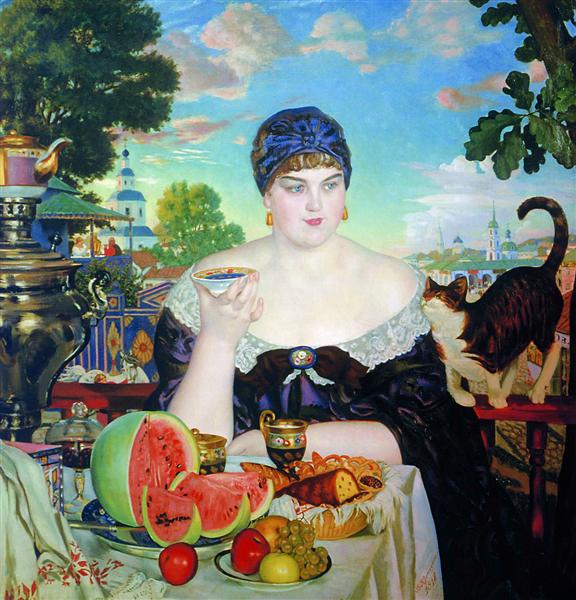
The Merchant's Wife at Tea
Boris Kustodiev, 1918
A central figure, the merchant's wife, anchors Boris Kustodiev’s 1918 oil on canvas, "The Merchant's Wife at Tea." This piece immediately brings to mind "the culture around the preparation and drinking of tea and the private and social settings in which this occurs," suggesting an intimate tableau. The choice of oil on canvas would allow Kustodiev to render the details of such a scene with a certain depth and texture, potentially highlighting the quiet richness of a domestic moment. As an artwork rooted in the Art Nouveau movement, one anticipates a visual language that integrates decorative elements and a sense of unified design, possibly extending to the furnishings or attire of the protagonist. The scene likely unfolds within a private setting, where the ritual of tea becomes a focal point, reflecting societal customs of the era. This painting, through its subject, invites reflection on how daily rituals shape identity and community, particularly within the refined aesthetic lens of Art Nouveau. What subtleties of status or personal reflection might Kustodiev have embedded within this seemingly simple act of taking tea?
No thoughts yet. Be the first to share one.
TagsArt Nouveau (Modern)oilcanvasportrait
5.00 (1 rating)
oil, canvas · 1918
Medium
oil, canvas
Period
Art Nouveau (Modern)