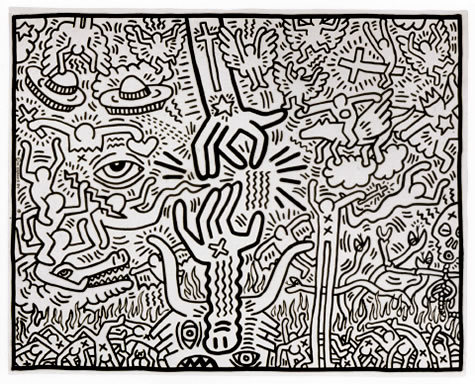
The Marriage of Heaven and Hell
Keith Haring, 1984
“The Marriage of Heaven and Hell,” a title from Keith Haring in 1984, immediately suggests a profound and perhaps jarring juxtaposition. Positioned within the Neo-Expressionist movement, this work would inherently carry the hallmarks of that energetic era: a raw emotionality, directness, and often a bold, unrefined aesthetic. Imagining how Haring's distinctive graphic language would interpret such a charged duality – the sacred and the profane, light and shadow – hints at a powerful, almost confrontational piece. The very act of attempting to marry these polar opposites speaks to a desire to explore complex truths, to find a unity amidst inherent conflict. The unknown medium adds another layer to this intrigue; one can only speculate if it manifests as a dynamic mural, a striking canvas, or some other form, each possibility suggesting different scales of impact and interaction with its audience. This isn't a gentle contemplation; Neo-Expressionism, especially in 1984, was about intensity. It leaves you wondering how Haring achieved that improbable union, and what unexpected truths emerged from the clash.
No thoughts yet. Be the first to share one.
TagsNeo-Expressionismfigurative
5.00 (1 rating)
1984
Period
Neo-Expressionism
.jpg)