The Last Supper
Church Santa Maria delle Grazie, Milan, Italy
Leonardo da Vinci, 1495
Painted in 1495 by Leonardo da Vinci, this High Renaissance masterpiece, created with plaster and tempera, adorns the Dominican monastery Santa Maria delle Grazie in Milan, commissioned by Duke Ludovico Sforza. The composition masterfully places Jesus at the center of a long table, flanked by his Apostles. The setting is a relatively plain room with dark tapestries, while three windows reveal a landscape reminiscent of Milan’s countryside. Leonardo’s use of linear perspective creates an illusion of space, drawing the viewer’s eye to Jesus through a single vanishing point at his right temple. Jesus, in traditional blue and red robes, lacks a halo, a detail scholars interpret as either an allusion through the light from the window or a sign of his human suffering. The artwork captures the dramatic moment Jesus announces his impending betrayal. His serene expression contrasts sharply with the Apostles' agitated reactions: James the Greater throws his arms out in anger, Thomas gestures skyward in questioning, and Phillip points to himself. Peter clutches a knife, while Judas, next to him, grips a purse and reaches for the same dish as Jesus, referencing the biblical prophecy. The experimental tempera and oil paint technique led to the work’s quick deterioration, prompting a controversial restoration completed in 1999, which recovered many details like food and facial expressions despite some dissatisfaction.
No thoughts yet. Be the first to share one.
TagsHigh Renaissanceplastertemperareligious painting
3.67 (3 ratings)
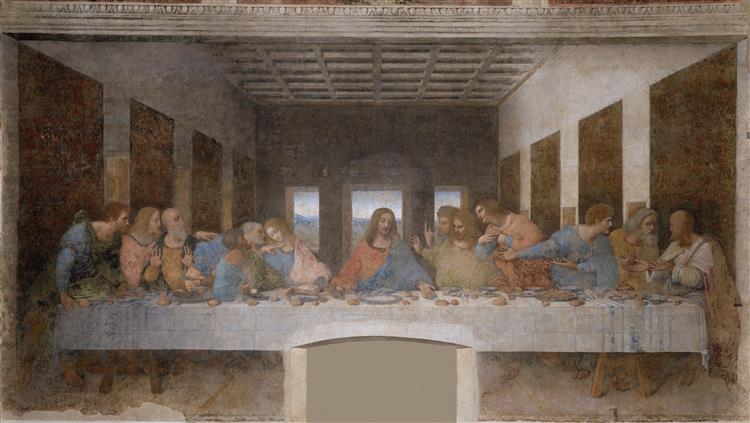
plaster, tempera · 1495
Medium
plaster, tempera
Period
High Renaissance
Held at
Church Santa Maria delle Grazie, Milan, Italy