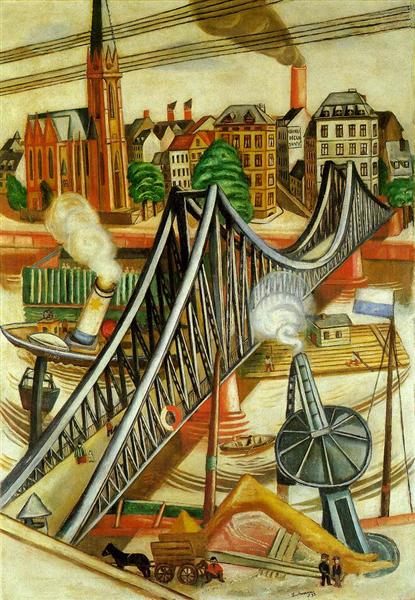
The Iron Bridge (View of Frankfurt)
Kunstsammlung Nordrhein-Westfalen, Düsseldorf, Germany
Max Beckmann, 1922
The fragmented world of an industrial landscape emerges from the canvas, a bold vision of a city's vital artery. Max Beckmann's 1922 oil on canvas captures the angularity and structural force inherent in a modern bridge. Expect to see the bridge's girders and supports rendered not as a unified whole, but as an array of interlocking planes, each facet perhaps shifting slightly to offer multiple perspectives simultaneously. The application of oil might lend a certain density or texture to these geometric divisions, hinting at the raw material of the structure itself. This depiction extends beyond just the bridge; it’s a 'View of Frankfurt,' suggesting the surrounding urban environment is integrated into this fractured perception. Buildings and perhaps the river itself would likely be broken down into their fundamental geometric components, reflecting the dynamic energy of a post-war European city. The oil medium allows for richness in these stark, analytical forms, creating a palpable sense of the scene’s construction. The raw strength of an iron bridge, typically a symbol of engineering might, becomes a subject for intellectual dissection here, transformed into a complex puzzle rather than a straightforward representation. This transformation challenges the viewer to reassemble the familiar into something new, to experience the city's infrastructure not just as functional, but as a subject for profound artistic reinterpretation. How does one piece together a city's identity when its very structures are presented as a series of shifting planes? This painting leaves one pondering the very nature of perception in a rapidly industrializing world.
No thoughts yet. Be the first to share one.
TagsCubismoilcanvascityscape
5.00 (1 rating)
oil, canvas · 1922
Medium
oil, canvas
Period
Cubism
Held at
Kunstsammlung Nordrhein-Westfalen, Düsseldorf, Germany