Paris Society
Solomon R. Guggenheim Museum, New York City, NY, US
Max Beckmann, 1947
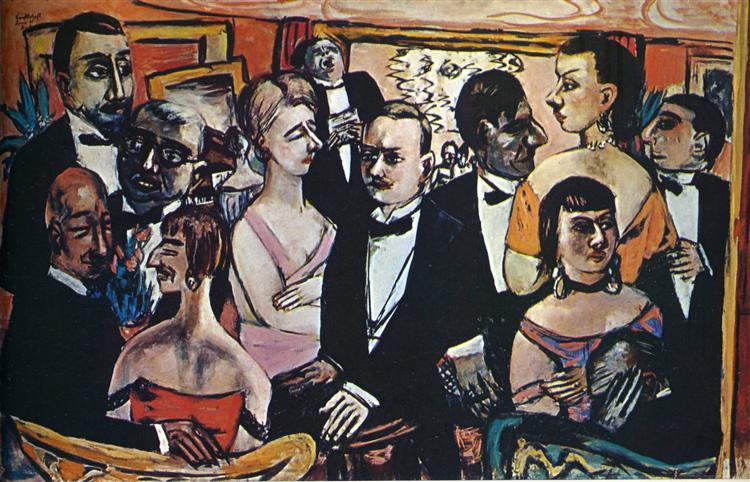
The title, "Paris Society," from 1947, already evokes a specific world, a post-war landscape potentially viewed through an Expressionist lens. This oil on canvas work by Max Beckmann, originating from a significant year, prompts contemplation on how such a setting might have been rendered by an artist deeply associated with the Expressionist movement. Without specific visual details from the available sources, one can only consider the implications of Beckmann's known style on a subject like "Paris Society." Expressionism often involved a departure from strict realism, favoring subjective emotional expression and distorted forms, perhaps to convey inner states or social commentary. Beckmann's choice of oil on canvas would allow for rich textures and bold applications of color, though the precise palette or compositional arrangement of this particular piece remains unilluminated by the provided details. The work's existence in 1947, a pivotal historical moment, suggests a potential dialogue with contemporary anxieties or observations on urban life. It leaves us wondering what specific visual language Beckmann employed to portray this "Paris Society"—was it vibrant, fractured, introspective, or critically observant? The details of its forms, colours, and figures are left to artistic imagination, based solely on its classification within Expressionism.
No thoughts yet. Be the first to share one.
TagsExpressionismoilcanvasgenre painting
5.00 (1 rating)
oil, canvas · 1947
Medium
oil, canvas
Period
Expressionism
Held at
Solomon R. Guggenheim Museum, New York City, NY, US