The Gross Clinic
Philadelphia Museum of Art, Philadelphia, PA, US
Thomas Eakins, 1875
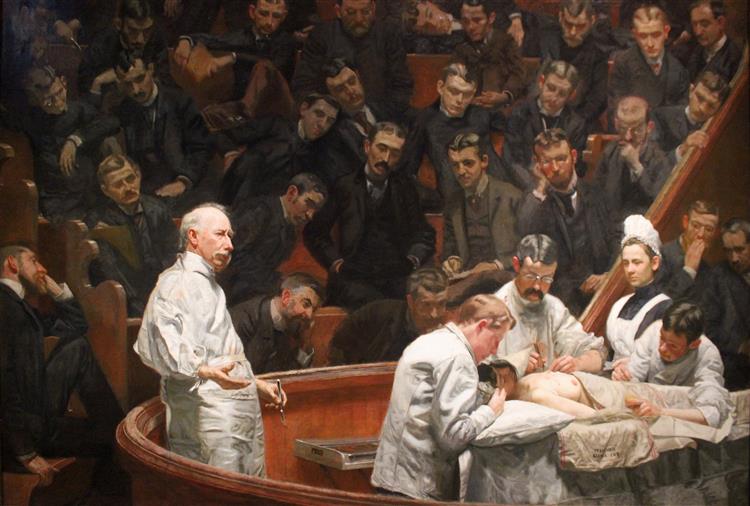
Thomas Eakins's deep connection to his birthplace remained a theme throughout his career. Perhaps his most well-known and ambitious work for the city of Philadelphia is The Gross Clinic, a painting completed in 1875 that spotlights the local physician Samuel David Gross. An intense scene is large in scale, measuring eight feet wide and over six feet across features Gross's teaching demonstration of a surgical procedure for the medical students. Five other doctors operate on a patient's infected thigh. This scientific endeavor contrasts sharply with the emotional reaction of the lone woman in the scene, presumably the patient's mother. Behind the operation on the right side of the painting, two figures watch the proceedings from the shadow of the room's doorway.The painting evokes Rembrandt's art historical precedent The Anatomy Lesson of Dr. Tulp (1632). Much like Rembrandt's version, The Gross Clinic documents sanitary medical procedures of its time, but the painting's real focus is living figures. Always a portraitist, Eakins calculated the work as a visual record of all the individuals present in the medical theater. Eakins inserted his own likeness among the audience - he's the figure at the far right, sketching. The core of the work is Dr. Gross, as light and composition conspire to attract the eye to the esteemed lecturer.This work is one of Eakins' most important, well-known, and controversial paintings. It provides a clear example of his interest in scientific study and medicine. Eakins paid great attention to the technical details of the surgery, and the scene also shows great artistic skill and design in the way that the artist illuminates the otherwise dark scene with a wash of light coming down on the pale skin of the patient and the white sheets on which he rests. Dramatic effect and keen use of color are also demonstrated in the clear bursts of red used to show the blood on the victim's body and the assistants as well as the scalpel held by Dr. Gross.Completed for the Centennial Exposition, The Gross Clinic was intended to be a statement of Eakins's artistic skill. Though the work was rejected by the selection committee, the artist's tactic was overall a success. While some critics lashed out against its gruesome subject matter, seemingly vulgar treatment, and inherent melodrama (note the near-swooning, hysterical woman in the left middle ground), viewers were nonetheless captivated by the work's theatricality. The painting was shown in the U.S. Army Post Hospital exhibition, not the main exhibition space - certainly a snub to the artist. Reactions were mixed with some praising Eakins for his study of anatomy, but most questioning the purpose of the painting and its morbidity. Now The Gross Clinic is recognized as one of the greatest American paintings ever made.
No thoughts yet. Be the first to share one.
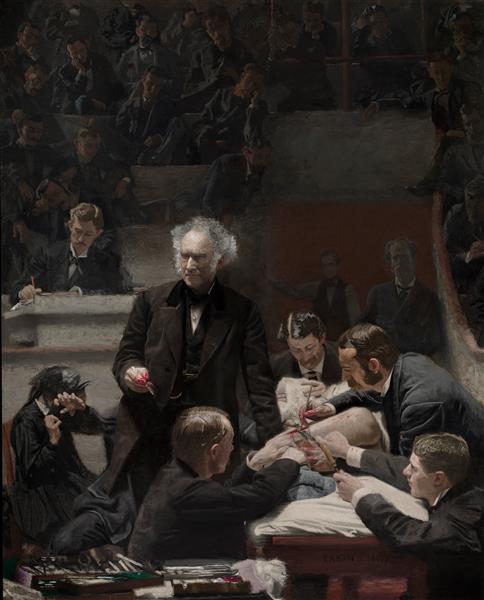
oil, canvas · 1875