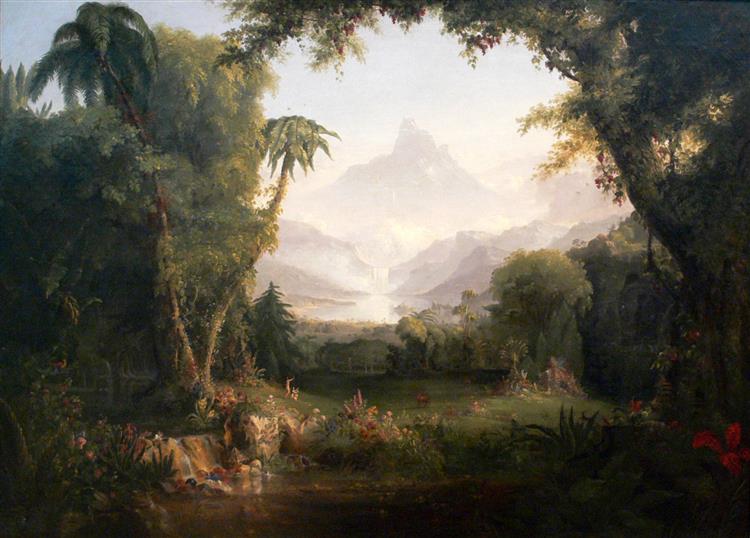
The Garden of Eden
Thomas Cole, 1828
Imagine a primordial landscape envisioned through the lens of early American Romanticism. Thomas Cole’s 1828 portrayal of The Garden of Eden, while specific visual details are elusive in available records, likely conjures a scene of unspoiled natural grandeur. Considering the Romantic movement's emphasis on emotion and the sublime, one might infer a composition overflowing with lush, vibrant foliage, perhaps towering, ancient trees framing a central vista, or a dramatic interplay of light and shadow suggesting a divine presence. The potential for verdant greens and serene blues, perhaps contrasted with an emerging dawn or a soft, golden twilight, would certainly align with the era’s fascination for nature's majesty. This painting probably seeks to transport the viewer to an idealized, Edenic world, a powerful theme for an artist deeply invested in the American wilderness as a reflection of spiritual truth. Without specific source material to confirm its precise palette or exact features, we are left to ponder how Cole, known for his sweeping landscapes, might have rendered this foundational biblical narrative, perhaps hinting at the fragility of such perfection or the profound beauty of a world before its eventual fall from grace.
No thoughts yet. Be the first to share one.
TagsRomanticismlandscape
4.00 (1 rating)
1828
Period
Romanticism