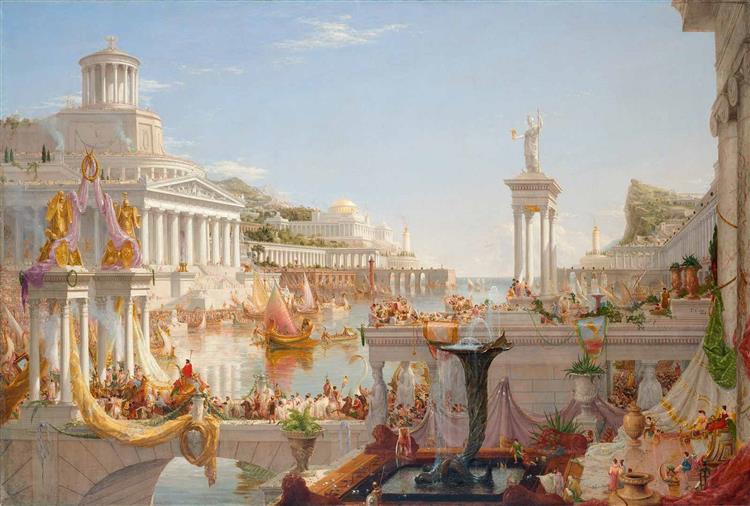
The Course of Empire: The Consummation of the Empire
New York Historical Society, New York City, NY, US
Thomas Cole, 1836
The sheer density of classical architecture in "The Consummation of Empire" feels both awe-inspiring and unsettling, a vibrant spectacle of civilization at its supposed peak. Classical porticos, rotundas, and statuary cram the scene, while a happy, colorful procession of citizens streams over a central bridge. Look closely to the right, and you'll spot a statue of Minerva, goddess of wisdom, an overlooked detail amidst the celebratory throngs. Even as a militaristic ruler is carried aloft, observe how nature, represented by a simple potted plant in the foreground, appears entirely subdued, almost an afterthought. This painting is the middle piece of Thomas Cole's "The Course of Empire" series, designed as a stark warning about the over-weaning ambitions of Empire. The very image of triumph here hints at its own collapse; the ignored Minerva and the militaristic leader suggest an empire too self-absorbed to heed wisdom or foresee its own decay. Cole’s anxiety about industry and urban expansion threatening the American landscape seems palpable, even in this grand vision of success. It makes you wonder, what truly constitutes a flourishing civilization if not just grand structures and parades? The series transforms the landscape genre, making it a powerful vehicle for social and political theory, questioning ambition even as it celebrates human achievement.
No thoughts yet. Be the first to share one.
TagsRomanticismoilcanvascityscapeallegorical painting
4.50 (1 rating)
oil, canvas · 1836
Medium
oil, canvas
Period
Romanticism
Held at
New York Historical Society, New York City, NY, US