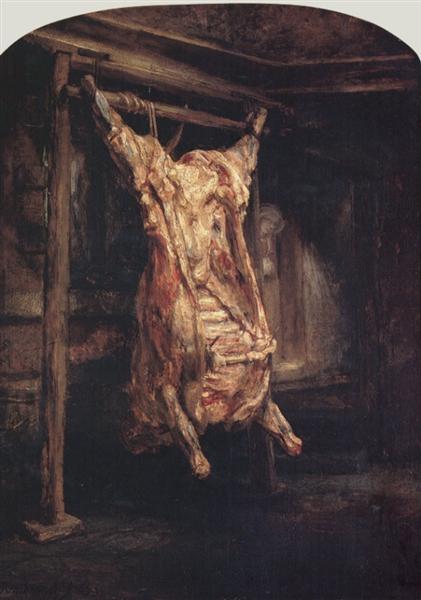
The Carcass of an Ox (Slaughtered Ox)
Louvre, Paris, France
Rembrandt, 1655
The Carcass of an Ox (Slaughtered Ox) by Rembrandt, painted in 1655 with oil on board, immediately confronts the viewer with a stark subject. This work, firmly within the Baroque movement and characterized by Tenebrism, plunges into the raw reality of a butchered animal. Such a depiction, by its very nature, brings forth elements that are often considered visually unpleasant, focusing on animal parts ready for human consumption. The choice to portray this intense scene, rather than a more conventional still life, demands attention. Rembrandt’s approach to such a visceral subject, especially given the dramatic light and shadow techniques associated with Tenebrism, would have undoubtedly aimed for a powerful, unflinching effect. This work, created in 1655, compels us to consider the often-hidden processes of daily life and consumption. While direct visual details of Rembrandt’s specific execution are not available in the provided sources, the thematic similarity to other depictions of butchery suggests a shared engagement with the challenging aesthetics of mortality and utility. It leaves us to ponder the artist's unique manipulation of light and form to transform this grim subject into a work of art.
No thoughts yet. Be the first to share one.
TagsBaroqueTenebrismoilboardstill life
3.50 (1 rating)
oil, board · 1655
Medium
oil, board
Period
Baroque · Tenebrism
Held at
Louvre, Paris, France