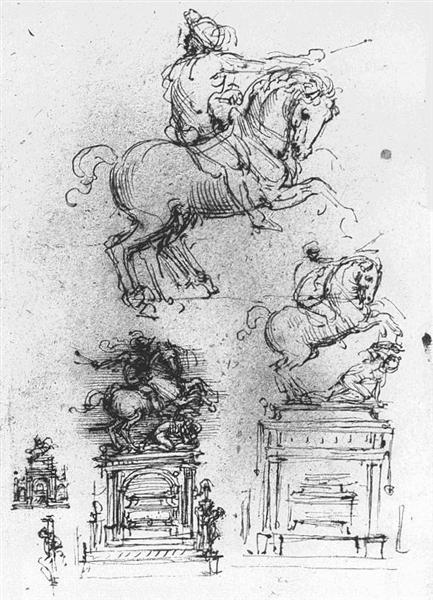
Study for the Trivulzio Equestrian Monument
Leonardo da Vinci, 1510
Imagine the sheer ambition of capturing an equestrian monument, not yet in bronze, but nascent on paper through Leonardo da Vinci's hand in 1510. This study, rendered solely in ink, would have focused intensely on the dynamic interplay of a powerful steed and its rider. One pictures the deliberate lines tracing muscle and sinew, the contours of both horse and figure articulated with an almost architectural precision. The monochromatic nature implied by the ink medium would strip away color, emphasizing form and volume, perhaps using wash to suggest shadow and depth. It’s a vision distilled to its most essential elements, revealing the underlying structure before any grander execution. For the High Renaissance, such a study wasn't merely a preparatory drawing; it was an exploration of ideal proportions and monumental presence. This work allows us to consider the countless experiments in pose and balance undertaken to create a sense of life and motion. It underscores the profound intellectual curiosity that preceded the physical creation, leaving us to ponder the immense visual problem-solving contained within these focused marks on paper.
No thoughts yet. Be the first to share one.
TagsHigh Renaissanceinkpapersketch and study
4.00 (1 rating)
ink, paper · 1510
Medium
ink, paper
Period
High Renaissance