Studies of human skull
Leonardo da Vinci, 1489
The raw precision of chalk and ink on paper immediately draws you into the stark subject of Leonardo da Vinci’s 1489 "Studies of human skull". This work from the Early Renaissance, conceived in chalk and ink on paper, is a rigorous visual dissection. One imagines the precise lines of ink delineating the intricate bone structure—perhaps the delicate nasal bones or the robust jaw—while the chalk would lend a more subtle depth, shading the hollows of the eyes and the curved surface of the cranium. The interaction of these two distinct media allows for both sharp definition and nuanced volume. This drawing likely offers multiple perspectives or close-ups, each stroke contributing to an almost architectural understanding of the skull's complex form. It's not about mortality in a somber sense, but rather the intense, living gaze applied to dead matter. The simple paper ground emphasizes the unadorned anatomical study, allowing the observer to share in da Vinci’s focused inquiry. It forces an intimate encounter with the bare architecture of life. What specific forms or hidden mechanics was da Vinci striving to unravel through these skeletal contours?
No thoughts yet. Be the first to share one.
TagsEarly Renaissancechalkinkpapersketch and study
5.00 (1 rating)
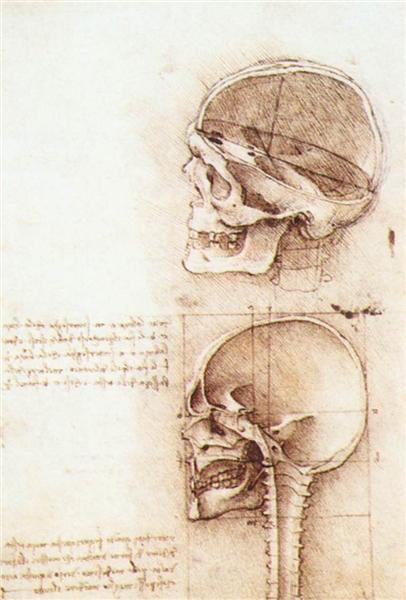
chalk, ink, paper · 1489
Medium
chalk, ink, paper
Period
Early Renaissance