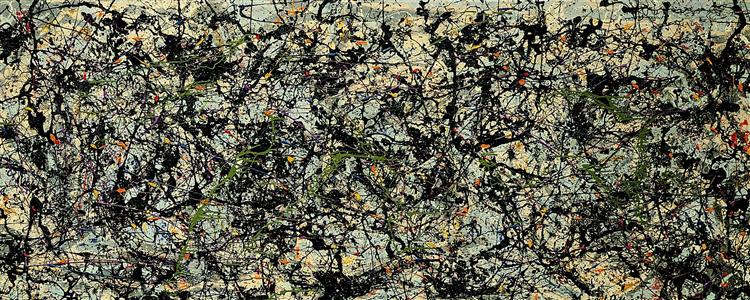
Number 1 (Lavender Mist)
National Gallery of Art, Washington, DC, US
Jackson Pollock, 1950
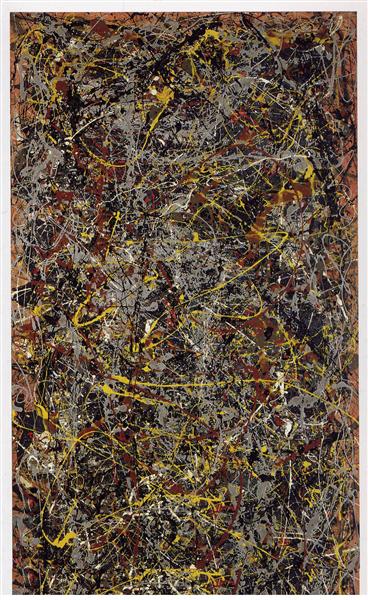
The surface of "Number 1 (Lavender Mist)" feels like a wild, intricate web, a chaotic assemblage of drips and splashes, where layers upon layers of oil and enamel paint are laid down with an intense energy. This isn't just a composition; it's a raw performance captured on canvas, a direct result of Pollock's drip action technique. Looking closely, one can trace the unpredictable paths of paint as they intersect and overlap, creating a depth that belies its flat surface. The irregularity of motion and shape arises directly from the act of painting itself. What really makes you think about this piece is how physicists have actually studied Pollock’s canvases, including "Lavender Mist," for naturally occurring fractals. The idea that such a chaotic presentation could mirror the intricate patterns of the natural world is fascinating. Research indicates that the more chaotic Pollock’s drippings became, the closer they resembled naturally occurring fractals, with his chronologically later paintings, like this 1950 work, displaying these characteristics more so than his earlier pieces. How much of this perceived chaos was intuition, and how much was an unconscious channeling of natural order? The work leaves you wondering about the fine line between spontaneity and an almost scientific precision in the creation of visual complexity.
No thoughts yet. Be the first to share one.
TagsAction paintingoilenamelcanvasabstract
3.00 (2 ratings)
.jpg!Large.jpg)
oil, enamel, canvas · 1950
Medium
oil, enamel, canvas
Period
Action painting
Held at
National Gallery of Art, Washington, DC, US
.jpg)