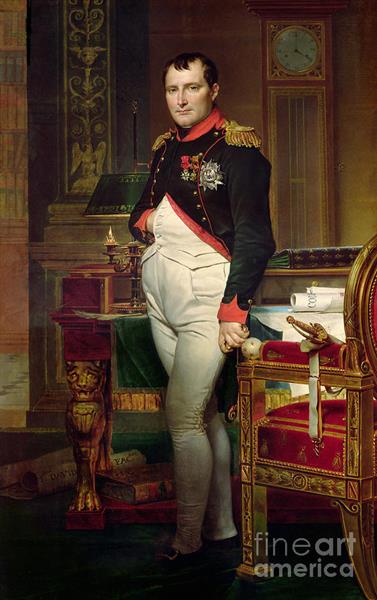
Napoleon Bonaparte in his Study at the Tuileries
Private Collection
Jacques-Louis David, 1812
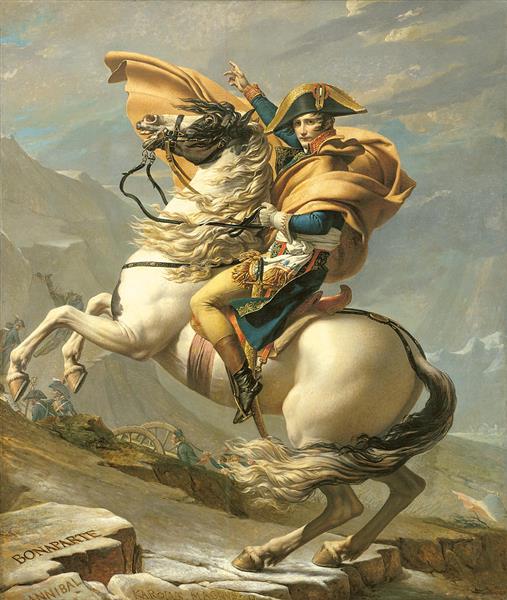
To stand before a portrayal of Napoleon from 1812, set "in his Study at the Tuileries," is to consider how a leader is presented in moments beyond the battlefield. Executed in oil on canvas, this work belongs to the Neoclassical movement, a style often associated with order and classical ideals. The artist, Jacques-Louis David, consistently depicted Napoleon in ways that conveyed a "strongly idealized view," as seen in his earlier equestrian portraits. In a study setting, one might anticipate seeing elements that underscore diligence or intellectual prowess. The composition would likely present Bonaparte not in the dramatic action of a military crossing, but perhaps seated or standing with symbols of statecraft, surrounded by books or maps. The controlled brushwork and refined finish characteristic of Neoclassicism, rendered in oil on canvas, would contribute to an image of calm authority. This deliberate framing, even when placing him in a seemingly private, reflective space, works to shape public perception. It leaves one pondering how such an intentional idealization, focusing on a more contemplative persona, aimed to solidify his image as a statesman, rather than just a conqueror.
No thoughts yet. Be the first to share one.
TagsNeoclassicismoilcanvasportrait
3.00 (1 rating)
oil, canvas · 1812
Medium
oil, canvas
Period
Neoclassicism
Held at
Private Collection