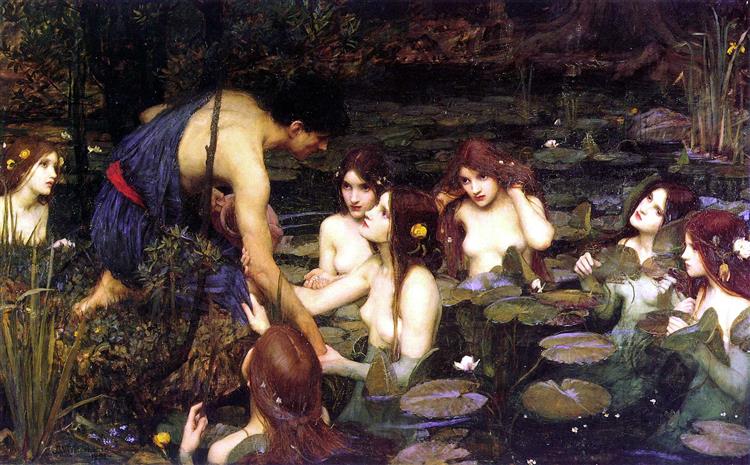
Hylas et les nymphes
Manchester Art Gallery, Manchester, UK
William Waterhouse John, 1896
The work, titled "Hylas et les nymphes," transports us into a world of classical myth, a subject often explored within the Romanticism movement of the late 19th century. Created in 1896 by William Waterhouse John, the oil on canvas medium likely leverages its inherent ability to build dramatic tension and rich atmospheric depth. We can imagine the scene unfolding, perhaps featuring Hylas surrounded by female humanlike beings, their allure a central focus, reminiscent of mythological figures known for their captivating voices. Such a setting could be depicted with the dramatic naturalism typical of Romantic art, possibly placing the figures amidst aquatic elements and formations of cliffs or rocks, creating an environment both beautiful and subtly perilous. The lack of direct visual documentation for the work itself from the provided sources means its precise rendering of these mythological elements—the specific hues, the nymphs' expressions, the play of light on water—remains an imaginative exercise. This absence of visual detail forces us to consider the enduring power of a title and a movement to conjure a world, leaving us to wonder about the specific brushstrokes that brought this particular mythological encounter to life.
No thoughts yet. Be the first to share one.
TagsRomanticismoilcanvasmythological painting
4.00 (1 rating)
oil, canvas · 1896
Medium
oil, canvas
Period
Romanticism
Held at
Manchester Art Gallery, Manchester, UK