Grillo
Private Collection
Jean-Michel Basquiat, 1984
The starkness of pencil on wood for Basquiat's 1984 work, Grillo, immediately commands attention. This choice of medium, raw and direct, resonates with the artist's roots in Street art and his characteristic Neo-Expressionist approach. Unlike traditional canvas, the wood likely provides a tactile, unforgiving surface, where every line from the pencil mark is laid bare. We can imagine the distinct texture of the wood grain interacting with the drawing, a fundamental tension between the material's natural state and the deliberate hand of the artist. While specific visual details for Grillo are elusive in the provided sources, a related artwork by Basquiat from the same year, Flexible, portrays a griot—a West African storyteller. Given the phonetic echo, it raises the possibility that Grillo too might delve into themes of oral tradition, cultural memory, or figures embodying knowledge. The very absence of color, relying solely on pencil on wood, underlines a powerful immediacy, stripping away adornment to focus on form and implied narrative. This work, in its elemental simplicity, prompts reflection on the raw power of communication and identity, challenging us to consider what foundational elements are truly necessary to convey a powerful message.
No thoughts yet. Be the first to share one.
TagsNeo-ExpressionismStreet artpencilwoodfigurative
4.00 (1 rating)
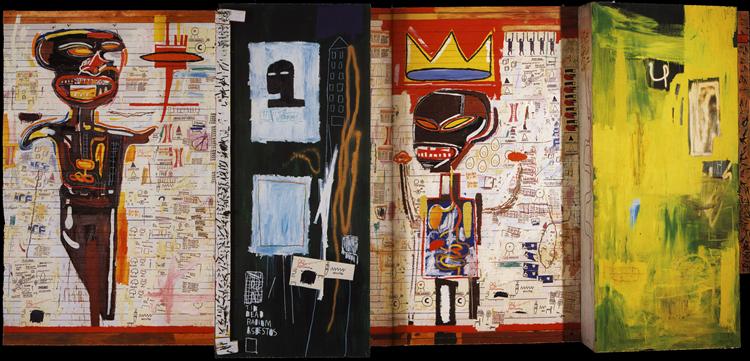
pencil, wood · 1984
Medium
pencil, wood
Period
Neo-Expressionism · Street art
Held at
Private Collection