Bishop
Daros Collection, Zürich, Switzerland
Jean-Michel Basquiat, 1983
The raw energy of Jean-Michel Basquiat's 'Bishop' from 1983 feels immediately apparent, even without direct visual access to the work. The choice of acrylic, charcoal, crayon, pastel, and pencil points to a layered, highly textured surface, characteristic of his approach. This multi-media combination suggests a deliberate tension between spontaneous mark-making and more controlled lines, allowing for both bold declarations and nuanced details to coexist. It’s the kind of blend that speaks to the Neo-Expressionist movement it belongs to, where a rough, almost primal honesty often defines the aesthetic. Furthermore, its connection to Street art hints at an immediate, unfiltered communication, bypassing traditional art world conventions. The varied tools employed would lend themselves to a powerful visual dialogue, pushing against clean lines in favor of a raw, almost urgent expression. One wonders how these distinct materials – the fluidity of acrylic, the grit of charcoal, the vibrancy of crayon and pastel, the precision of pencil – interact to build a singular, complex image, perhaps a figure or symbol, that carries Basquiat’s unique intensity. The very nature of these media implies a painting that demands close inspection, revealing new details in its interwoven surfaces.
No thoughts yet. Be the first to share one.
TagsNeo-ExpressionismStreet artacryliccharcoalcrayonpastelpencilfigurative
4.00 (1 rating)
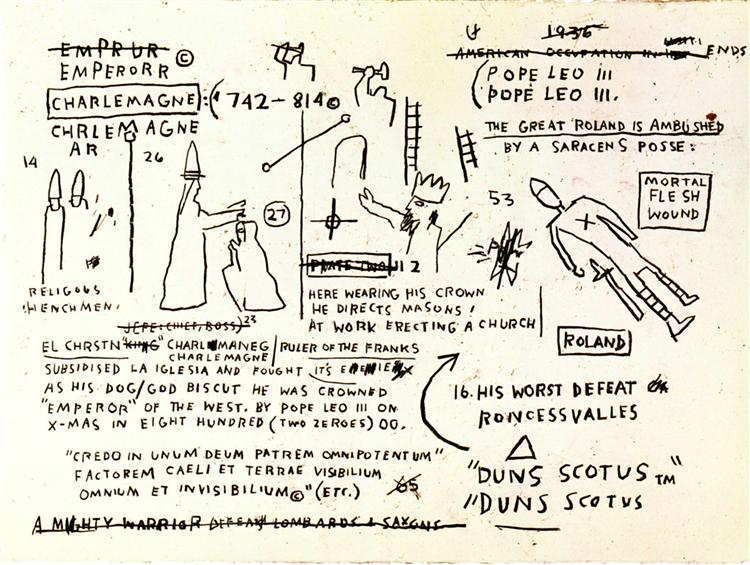
acrylic, charcoal, crayon, pastel, pencil · 1983
Medium
acrylic, charcoal, crayon, pastel, pencil
Period
Neo-Expressionism · Street art
Held at
Daros Collection, Zürich, Switzerland