Beatles
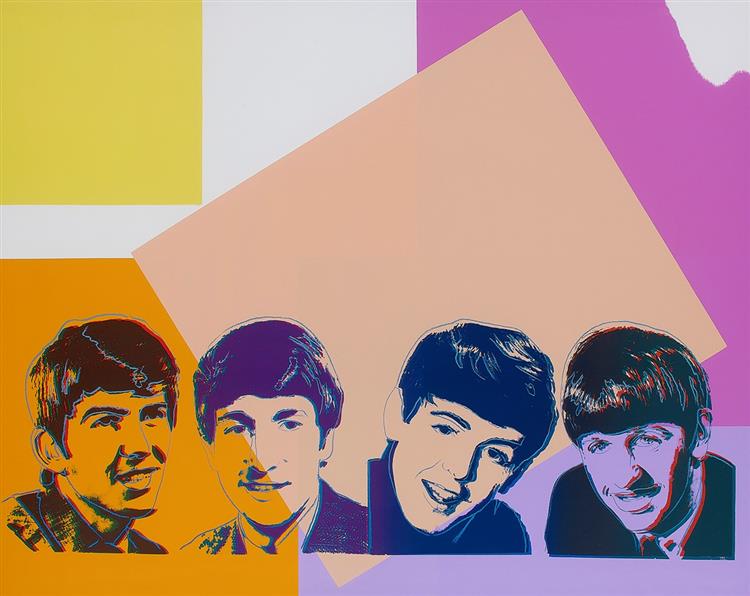
Andy Warhol, 1980
The decision to render the iconic imagery of The Beatles using screenprint, a method associated with mass production, immediately places this 1980 work by Andy Warhol in a fascinating dialogue about celebrity and commercialism. Screenprinting, as a technique, inherently allows for the repetition and subtle variations across multiple impressions, visually echoing the pervasive way popular figures like The Beatles were disseminated through various media. Warhol, renowned for his use of this medium in works such as the portfolio of ten screenprints for 'Campbell's Soup I,' frequently leveraged its graphic qualities to explore the ubiquitous nature of imagery in consumer culture. This choice for the 'Beatles' isn't about a fleeting moment or a painterly interpretation, but rather about presenting the subjects as a widely consumed, almost manufactured, presence. The characteristic flat planes of color and stark outlines typical of screenprints would have transformed the band members into graphic symbols, ready for endless reproduction and blurring the line between individuals and a universal brand. This visual transformation from musicians to commercial icons, enacted through the very medium of a Pop Art screenprint, leaves us to ponder the nature of fame itself: an image infinitely replicated, yet perhaps, paradoxically, less tangible with each iteration.
No thoughts yet. Be the first to share one.
TagsPop Artscreenprintportrait
0.50 (1 rating)
screenprint · 1980
Medium
screenprint
Period
Pop Art