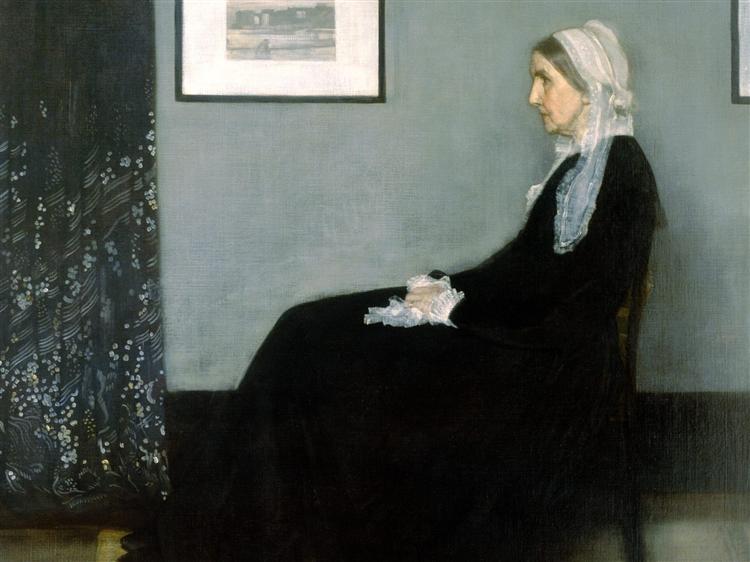
Arrangement in Grey and Black No.1, Portrait of the Artist's Mother
Musée d'Orsay, Paris, France
McNeill Whistler James, 1871
The figure of Anna McNeill Whistler, dressed in a stark black gown and a white lace cap, is striking, captured in a seated profile. Her hands rest quietly, holding a white handkerchief, a small detail against the muted tones that pervade the canvas. Behind her, a reproduction of her son's View of the Thames hangs on the wall, subtly anchoring her presence within his artistic world. A Japanese-inspired floral pattern adorns the curtain to the left, and his signature butterfly symbol, a personal touch, peeks from the upper right corner. There's a deliberate balance to the composition; the rectangular shapes of the background picture, the curtain, and the floor meticulously stabilize her form. Whistler, known for eschewing sentimentality and advocating "art for art's sake," presented a work that, despite its formal rigor and carefully orchestrated greys and blacks, became widely interpreted as a profound symbol of motherhood or mourning. It is fascinating how the work, originally conceived when Anna posed out of necessity due to a model’s cancellation, has resonated so widely.
No thoughts yet. Be the first to share one.
TagsRealismoilcanvasportrait
3.50 (1 rating)
oil, canvas · 1871
Medium
oil, canvas
Period
Realism
Held at
Musée d'Orsay, Paris, France