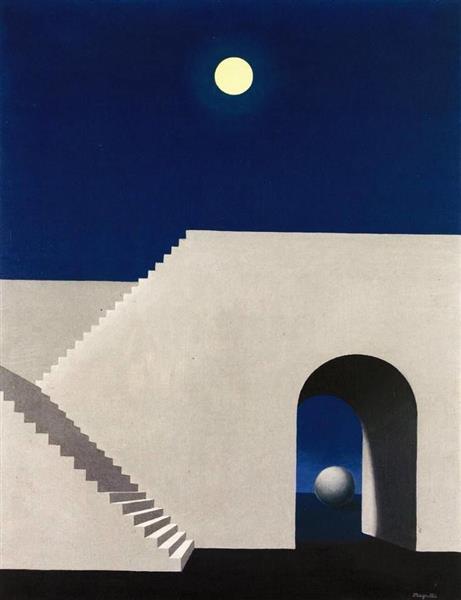
Architecture au clair de lune
Rene Magritte, 1956
The juxtaposition implied by "Architecture au clair de lune" suggests a scene where familiar structures are steeped in an otherworldly luminescence. As an oil work from 1956 by Rene Magritte, it undoubtedly draws on the Surrealist tradition of unsettling the viewer's perception. Imagine solid, earthbound architecture, perhaps a classical building or an urban facade, not under the stark clarity of day, but under the soft, transforming glow of moonlight. This light would not simply illuminate; it would likely distort, casting long, ambiguous shadows and perhaps rendering familiar forms strangely unfamiliar. The very notion of "clair de lune" implies a dreamlike quality, where the logical world of constructed space bends to the logic of the subconscious. One might anticipate a quiet tension, the solidity of stone dissolving into atmospheric mystery, challenging what we understand about permanence and illusion. What remains is a powerful evocation of how light can reshape reality, inviting contemplation on the hidden aspects of everyday scenes.
No thoughts yet. Be the first to share one.
TagsSurrealismoilarchitecture
4.50 (1 rating)
oil · 1956
Medium
oil
Period
Surrealism
.jpg!Large.jpg)
.jpg!Large.jpg)
.jpg!Large.jpg)
.jpg!Large.jpg)