Unexpected Visitors
Tretyakov Gallery, Moscow, Russia
Ilya Repin, 1888
The hushed, almost stunned expressions of the household in "Unexpected Visitors" are truly striking, especially knowing Ilya Repin repainted the young man's face four times in search of a proper expression for the returning political exile. This is the second, more expansive version of the work, evolving from an earlier 1883 painting that featured fewer characters and a main figure who was a young girl. Repin worked on this scene in his own living room at his country house, using his wife, mother-in-law, and daughter as models for the female characters, grounding the tension in an undeniable domestic intimacy. Even after its exposure in a Traveling Art Exhibition, Repin continued to refine the painting for another four years, emphasizing his dedication to its message. It's widely believed that by meticulously portraying the varied reactions of the family members, Repin aimed to subtly illustrate diverse, yet mostly favorable, societal sentiments toward the revolutionary movements of the time. This makes the seemingly ordinary arrival an astonishingly bold political declaration, masterfully disguised as a simple genre scene under the heavy hand of Czarist Russian censorship.
No thoughts yet. Be the first to share one.
TagsRealismoilcanvasgenre painting
4.50 (1 rating)
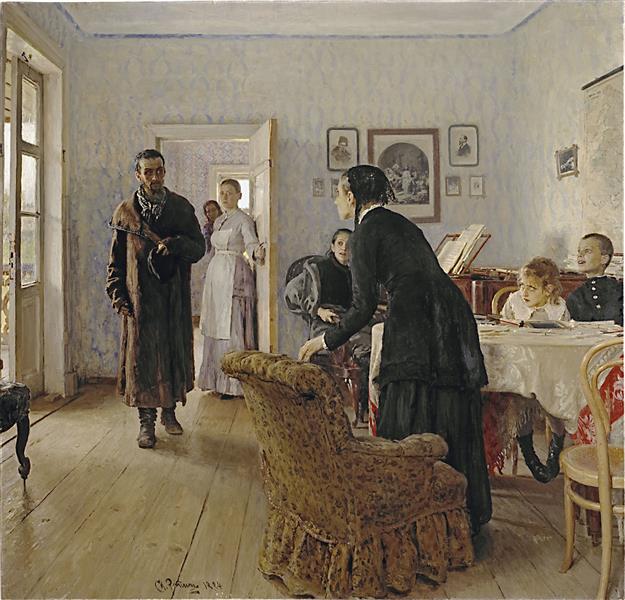
oil, canvas · 1888
Medium
oil, canvas
Period
Realism
Held at
Tretyakov Gallery, Moscow, Russia