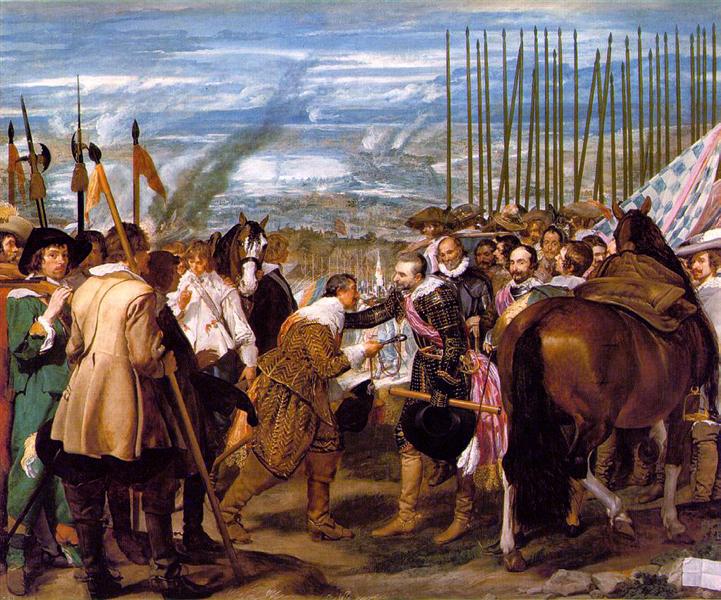
The Surrender of Breda
Museo del Prado, Madrid, Spain
Diego Velazquez, 1635
The central drama in Velázquez’s "The Surrender of Breda" is a deceptively simple gesture: the exchange of the key from the Dutch to the Spanish. Painted in oil on canvas during 1634 and 1635, this Baroque artwork portrays a pivotal moment with striking detail, moving beyond mere documentation. The composition draws you into the meeting of two groups, one relinquishing authority, the other accepting it. It's truly compelling to consider that Velázquez was inspired to create this work after a visit to Italy, traveling with Ambrogio Spinola himself, the Genoese-born Spanish general who famously conquered Breda a decade earlier, on June 5, 1625. This direct, personal connection to one of the central figures must have profoundly shaped his vision. It’s not just the transfer of a physical object, but a complex interaction between victors and vanquished. The artwork captures a tension in this moment of surrender, a quiet dignity in the act of handing over Breda’s key, leaving us to ponder the nuanced humanity within such a significant historical event.
No thoughts yet. Be the first to share one.
TagsBaroqueoilcanvasbattle painting
4.50 (1 rating)
oil, canvas · 1635
Medium
oil, canvas
Period
Baroque
Held at
Museo del Prado, Madrid, Spain