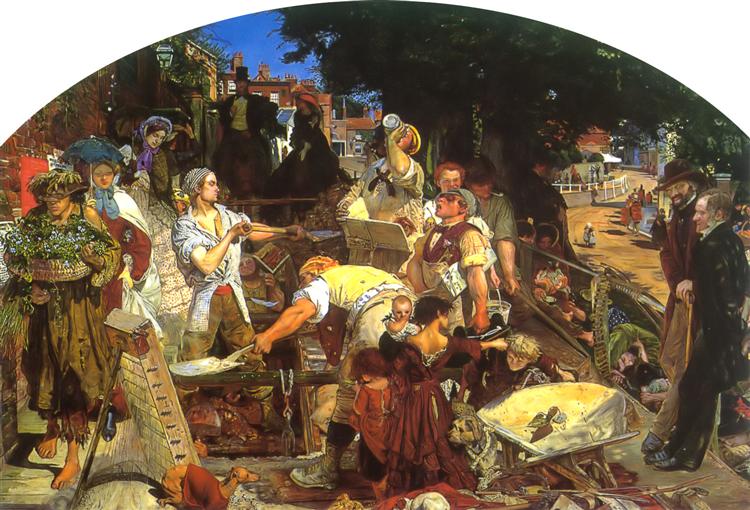
The Seeds and Fruit of English Poetry
Ashmolean Museum, Oxford, UK
Madox Brown Ford, 1845
The very title, "The Seeds and Fruit of English Poetry," from Madox Brown Ford's 1845 creation, immediately sparks an imaginative landscape. Crafted in oil on canvas, this artwork, born from the Romanticism movement, must grapple with the challenge of visualizing the intangible. One might envision a verdant, almost overflowing scene, where the germination of poetic thought is depicted as tender shoots emerging from rich soil. The "fruit" would then manifest as fully formed, perhaps symbolic, ripe elements—each suggesting a major work or a period of literary flourishing. Given the Romantic era, the color palette could embrace deep, resonant tones: the solemnity of dark greens for enduring legacy, touches of earthy ochre for foundational origins, and bursts of vibrant reds or golden yellows to signify the passion and beauty of English verse. The ambition to render such an abstract concept through natural allegory, where poetry itself becomes a living, growing entity, is profound. This approach transforms a body of literature into something organic and cyclical, hinting at both its origins and its continuing yield through time, a truly captivating thought. It makes one consider the quiet power of creation, and how ideas, like seeds, take root and blossom.
No thoughts yet. Be the first to share one.
TagsRomanticismoilcanvasallegorical painting
4.00 (1 rating)

oil, canvas · 1845
Medium
oil, canvas
Period
Romanticism
Held at
Ashmolean Museum, Oxford, UK
.jpg!Large.jpg)
.jpg!Large.jpg)